


Page 74 - IJPS-2-2
P. 74
Transition in risks of higher order births in Nepal: a life table analysis
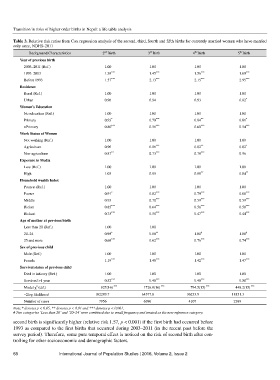
Table 3. Relative risk ratios from Cox regression analysis of the second, third, fourth and fifth births for currently married women who have married
only once, NDHS-2011
th
nd
th
rd
Background Characteristics 2 Birth 3 Birth 4 Birth 5 Birth
Year of previous birth
2003–2011 (Ref.) 1.00 1.00 1.00 1.00
***
***
***
***
1993–2003 1.39 1.45 1.56 1.69
***
***
***
***
Before 1993 1.57 2.13 2.15 2.95
Residence
Rural (Ref.) 1.00 1.00 1.00 1.00
Urban 0.96 0.94 0.93 0.82
*
Women’s Education
No education (Ref.) 1.00 1.00 1.00 1.00
*
***
**
Primary 0.93 * 0.79 0.84 0.81
***
***
***
***
>Primary 0.80 0.56 0.60 0.54
Work Status of Women
Not working (Ref.) 1.00 1.00 1.00 1.00
*
**
***
Agriculture 0.96 0.86 0.82 0.82
***
***
**
Non-agriculture 0.87 0.73 0.78 0.96
Exposure to Media
Low (Ref.) 1.00 1.00 1.00 1.00
**
**
High 1.03 0.95 0.88 0.84
Household wealth Index
Poorest (Ref.) 1.00 1.00 1.00 1.00
***
Poorer 0.91 * 0.82 0.79 0.68
***
***
Middle 0.93 0.70 0.59 0.59
***
***
***
***
***
***
***
Richer 0.85 0.64 0.56 0.50
***
***
***
***
Richest 0.75 0.50 0.47 0.44
Age of mother at previous birth
Less than 20 (Ref.) 1.00 1.00
20–24 0.95 * 0.88 1.00 # 1.00
**
#
***
***
***
***
25 and more 0.69 0.62 0.76 0.74
Sex of previous child
Male (Ref.) 1.00 1.00 1.00 1.00
***
***
Female 1.19 1.48 1.42 1.47
***
***
Survival status of previous child
Died in infancy (Ref.) 1.00 1.00 1.00 1.00
***
***
***
***
Survived >1 year 0.52 0.48 0.48 0.50
2
Model χ (d.f.) 927(16) *** 1726.9(16) *** 794.5(15) *** 448.2(15) ***
−2log likelihood 102289.7 64577.8 36233.9 18151.3
Number of cases 7956 6396 4107 2389
Note:* denotes p < 0.05, ** denotes p < 0.01 and *** denotes p < 0.001.
# Two categories ‘Less than 20’ and ‘20–24’ were combined due to small frequency and treated as the new reference category.
second birth is significantly higher (relative risk 1.57, p < 0.001) if the first birth had occurred before
1993 as compared to the first births that occurred during 2003–2011 (in the recent past before the
survey period). Therefore, some pure temporal effect is noticed on the risk of second birth after con-
trolling for other socioeconomic and demographic factors.
68 International Journal of Population Studies | 2016, Volume 2, Issue 2

