


Page 33 - IMO-1-1
P. 33
Innovative Medicines & Omics                                         Antioxidant nanomedicines for therapies


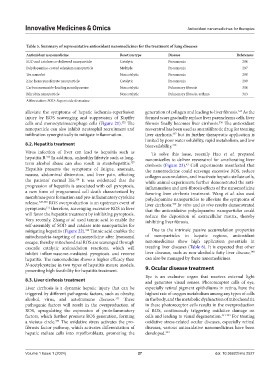
            Table 5. Summary of representative antioxidant nanomedicines for the treatment of lung diseases
            Antioxidant nanomedicine                Reaction type        Disease                      References
            SOD and catalase co-delivered nanoparticle  Catalytic        Pneumonia                      296
            Polydopamine-coated selenium nanoparticle  Multiple          Pneumonia                      297
            Tea nanodot                             Noncatalytic         Pneumonia                      298
            Zinc hexacyanoferrate nanoparticle      Catalytic            Pneumonia                      299
            Carbon monoxide-loading nanoliposome    Noncatalytic         Pulmonary fibrosis             306
            Bilirubin nanoparticle                  Noncatalytic         Pulmonary fibrosis, asthma     313
            Abbreviation: SOD: Superoxide dismutase

            alleviate  the  symptoms  of  hepatic  ischemia-reperfusion   generation of collagen and leading to liver fibrosis.  As the
                                                                                                      335
            injury by ROS scavenging and suppression of Kupffer   formed scars gradually replace liver parenchyma cells, liver
            cells and monocyte/macrophage cells (Figure 21).  The   fibrosis finally becomes liver cirrhosis.  The antioxidant
                                                                                              336
                                                     325
            nanoparticle can also inhibit neutrophil recruitment and   resveratrol has been used as an antifibrotic drug for treating
            infiltration synergistically to mitigate inflammation.  liver cirrhosis,  but its further therapeutic application is
                                                                          337
                                                               limited by poor water solubility, rapid metabolism, and low
            8.2. Hepatitis treatment                           bioavailability. 338
            Virus  infection  of  liver  can  lead  to  hepatitis  such  as   To solve this issue, recently Hao  et al. prepared
            hepatitis B.  In addition, unhealthy lifestyle such as long-  nanomicelles to deliver resveratrol for ameliorating liver
                     326
            term  alcohol  abuse  can  also  result  in  steatohepatitis.    cirrhosis (Figure 23).  Cell experiments manifested that
                                                         327
                                                                                41
            Hepatitis presents the symptoms of fatigue, anorexia,   the nanomedicine could scavenge excessive ROS, reduce
            nausea, abdominal distension, and liver pain, affecting   collagen accumulation, and inactivate hepatic stellate cells,
            the  patients’  normal  life.   It  was  evidenced  that  the   while animal experiments further demonstrated the anti-
                                 328
            progression of hepatitis is associated with cell pyroptosis,   inflammation and anti-fibrosis effects of the nanomedicine
            a  new form  of  programmed cell death characterized  by   favoring  liver  cirrhosis  treatment.  Wang  et al. also used
            membrane pore formation and pro-inflammatory cytokine   polydopamine nanoparticles to alleviate the symptoms of
            release. 329,330  ROS overproduction is an upstream event of   liver cirrhosis.  In vitro and in vivo results demonstrated
                                                                          339
            pyroptosis;  therefore, scavenging excessive ROS in liver   that the antioxidative polydopamine nanoparticles could
                     331
            will favor the hepatitis treatment by inhibiting pyroptosis.   reduce the deposition of extracellular matrix, thereby
            Very recently, Zhang et al. used tannic acid to enable the   inhibiting liver fibrosis.
            self-assembly of SOD and catalase into nanoparticles for
            mitigating hepatitis (Figure 22).  Tannic acid enables the   Due to the intrinsic passive accumulation properties
                                     332
            mitochondria-targeting of nanomedicine after lysosomal   of nanoparticles in hepatic regions, antioxidant
            escape, thereby mitochondrial ROS are scavenged through   nanomedicines show high application potentials in
            cascade catalytic antioxidation reactions, which will   treating liver diseases (Table 6). It is expected that other
                                                                                                            340
            inhibit  inflammasome-mediated  pyroptosis  and  reverse   liver diseases, such as non-alcoholic fatty liver disease,
            hepatitis. The nanomedicine shows a higher efficacy than   can also be managed by these nanomedicines.
            N-acetylcysteine in two types of hepatitis mouse models,
            presenting high feasibility for hepatitis treatment.  9. Ocular disease treatment
                                                               Eye  is an  exclusive  organ  that  receives  external  light
            8.3. Liver cirrhosis treatment                     and  generates  visual  senses.  Photoreceptor  cells  of  eye,
            Liver cirrhosis is a dynamic hepatic injury that can be   especially retinal pigment epitheliums in retina, have the
            triggered by different pathogenic factors, such as obesity,   highest rate of oxygen metabolism among any types of cells
            alcohol, virus, and autoimmune diseases.  These    in the body, and the metabolic dysfunction of mitochondria
                                                  333
            pathogenic factors will result in the overproduction of   in these photoreceptor cells results in the overproduction
            ROS, upregulating the expression of proinflammatory   of ROS, continuously triggering oxidative damage on
            factors, which further promote ROS generation, forming   cells and leading to visual degeneration. 341-343  For treating
            a  vicious  circle.   The  oxidative  stress  activates  the  pro-  oxidative  stress-related  ocular  diseases,  especially  retinal
                         334
            fibrosis factor pathway, which activates differentiation of   diseases, various antioxidative nanomedicines have been
            hepatic stellate cells into myofibroblasts, promoting the   developed. 344


            Volume 1 Issue 1 (2024)                         27                               doi: 10.36922/imo.2527

