


Page 31 - IMO-1-1
P. 31
Innovative Medicines & Omics                                         Antioxidant nanomedicines for therapies


            in which the two components can scavenge ROS       secondary  MRSA  infection.  Recently,  we  also  fabricated
                       297
            synergistically.  The nanoparticle was also demonstrated   zinc hexacyanoferrate nanoparticles for treating bacterial
                                                                        299
            to be capable  of alleviating inflammatory  response in a   pneumonia,  which can mimic the catalytic activities
            lipopolysaccharide-induced lung inflammation model.  of both SOD and catalase to scavenge ROS efficiently,
                                                               alleviating  inflammation.  In  addition,  the  nanoparticles
              To  achieve  concurrent  anti-inflammation  and   also  present  broad-spectrum  antibacterial  property
            pathogen eradication, the antioxidant nanomedicines   against various pathogenic bacteria, due to the release of
            should  have  antiviral/antibacterial  property.  Li  et al.   antibacterial Zn  cations. The synergistic actions of anti-
                                                                            2+
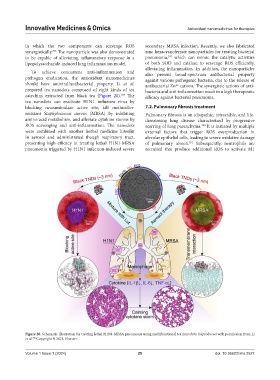
            prepared tea nanodots composed of eight kinds of tea   bacteria and anti-inflammation result in a high therapeutic
            catechins extracted from black tea (Figure  20).  The   efficacy against bacterial pneumonia.
                                                     298
            tea nanodots can eradicate H1N1 influenza virus by
            blocking  neuraminidase  active  site,  kill  methicillin-  7.2. Pulmonary fibrosis treatment
            resistant  Staphylococcus aureus  (MRSA)  by  inhibiting   Pulmonary fibrosis is an idiopathic, intractable, and life-
            amino acid metabolism, and alleviate cytokine storms by   threatening lung disease characterized by progressive
            ROS  scavenging  and  anti-inflammation.  The  nanodots   scarring of lung parenchyma.  It is initiated by multiple
                                                                                       300
            were combined with another herbal medicine luteolin   external factors that trigger ROS overproduction in
            in aerosol and administrated though respiratory tract,   alveolar epithelial cells, leading to severe oxidative damage
            presenting  high  efficacy  in  treating  lethal  H1N1-MRSA   of  pulmonary  alveoli.   Subsequently,  neutrophils  are
                                                                                 301
            pneumonia  triggered  by  H1N1  infection-induced  severe   recruited that produce additional ROS to activate M1


            Figure 20. Schematic illustration for treating lethal H1N1-MRSA pneumonia using multifunctional tea nanodots. Reproduced with permission from Li
            et al.  Copyright © 2021, Elsevier.
               298

            Volume 1 Issue 1 (2024)                         25                               doi: 10.36922/imo.2527

