


Page 36 - IMO-1-1
P. 36
Innovative Medicines & Omics                                         Antioxidant nanomedicines for therapies


            have been used for mitigating macular oxidative stress, but   last for 56 days, owing to the sustained release of resveratrol
            till now they have not been approved for AMD treatment   antioxidant from the nanomedicine.
            due to low efficacy. 361                              The antioxidative effect of intravitreally administrated
              Antioxidant  nanomedicines  have  provided  new   antioxidant  nanomedicines  should  be  long-lasting  and
            approaches  for  scavenging  macular  ROS.  Luo  et al.   sustainable to remove the need for multiple intravitreal
            prepared  a  poly(catechin)  antioxidant-based  composite   injection  and  eye  puncture.  Therefore,  antioxidant
            nanomedicine,  which  was  demonstrated  to  alleviate   nanocatalysts present advantages to trigger a continuous
            macular degeneration in an animal model through a   catalytic ROS-scavenging effect in the retina. Chen et al.
            single  intravitreal  injection.   Very  recently,  Nguyen  et   first reported that CeO  nanoparticles can prevent retinal
                                   362
                                                                                  2
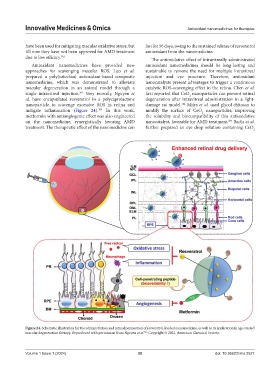
            al. have encapsulated resveratrol in a polycaprolactone   degeneration  after  intravitreal  administration  in  a  light-
            nanoparticle  to  scavenge  excessive  ROS  in  retina  and   damage rat model.  Mitra et al. used glycol chitosan to
                                                                              364
            mitigate inflammation (Figure  24).   In  this  work,   modify the surface of CeO  nanoparticles, improving
                                           363
                                                                                       2
            metformin with antiangiogenic effect was also engineered   the solubility and biocompatibility of this antioxidative
            on  the  nanomedicine,  synergistically  favoring  AMD   nanocatalyst, favorable for AMD treatment.  Badia et al.
                                                                                                  365
            treatment. The therapeutic effect of the nanomedicine can   further prepared an eye drop solution containing CeO
                                                                                                             2


            Figure 24. Schematic illustration for the administration and retinal permeation of resveratrol-loaded nanomedicine, as well as its application in age-related
            macular degeneration therapy. Reproduced with permission from Nguyen et al.  Copyright © 2022, American Chemical Society.
                                                              363


            Volume 1 Issue 1 (2024)                         30                               doi: 10.36922/imo.2527

