


Page 39 - IMO-1-1
P. 39
Innovative Medicines & Omics                                         Antioxidant nanomedicines for therapies


            Q have also been reported to have low efficacy due to their   Nanomaterials with intrinsic antioxidative properties,
            low bioavailability. 395                           such  as  zero-valent-molybdenum  nanodots,  melanin
                                                                                                    400
                                                                          401
                                                                                                            402
              In the past decade, various antioxidative nanomedicines   nanoparticles,   and  polyphenol-based  nanoparticles,
            have been used for treating inflammatory bowel disease.    have also been used for alleviating intestinal inflammation
                                                         396
            Most nanomedicines are delivered via oral route, and thus   by  neutralizing  ROS,  during  which  the nanomaterials
            they need to be highly stable to endure the harsh gastric   are oxidized and degraded. To prolong the antioxidative
            environment abundant with acidic gastric fluid and digestive   therapeutic effect, various antioxidant nanocatalysts have
                                               397
            enzymes before reaching the intestinal tract.  In addition,   been used to trigger catalytic antioxidation reactions
            as the inflamed intestinal mucosa is enriched with positively   in  inflamed  intestinal  tract.  Zhao  et al. grew CeO
                                                                                                             2
            charged proteins such as transferrin,  while the surfaces of   nanoparticles  on  montmorillonite,  which  is  negatively-
                                        398
            nanomedicines are usually negative,  these nanomedicines   charged  and  can  be  adsorbed  on  positively-charged
                                        36
            can accumulate in inflamed region efficiently through   inflamed intestinal tissue, favoring CeO -based  catalytic
                                                                                                2
                                                                                                        403
            electrostatic  interaction.  Xu  et al.  prepared  a  diselenide-  antioxidation  reactions  to  mitigate  inflammation.  Liu
            bridged hyaluronic acid nanoparticle for mitigating   et al. encapsulated Pt nanoparticles in a Mn porphyrin-
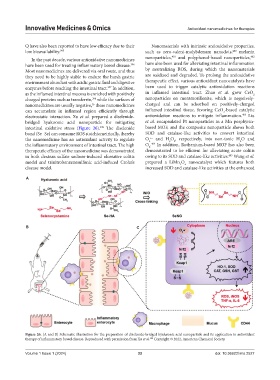
            intestinal oxidative stress (Figure  26).  The diselenide   based MOF, and the composite nanoparticle shows both
                                            399
            bond (Se−Se) can consume ROS stoichiometrically, thereby   SOD  and  catalase-like  activities  to  convert  intestinal
                                                                 •−
            the nanomedicine has an antioxidant activity to regulate   O   and  H O ,  respectively,  into  non-toxic  H O  and
                                                                         2
                                                                           2
                                                                                                       2
                                                                2
                                                                 404
            the inflammatory environment of intestinal tract. The high   O .  In addition, Ruthenium-based MOF has also been
                                                                2
            therapeutic efficacy of the nanomedicine was demonstrated   demonstrated to be efficient for alleviating acute colitis
            in both dextran sulfate sodium-induced ulcerative colitis   owing to its SOD and catalase-like activities.  Wang et al.
                                                                                                  405
            model  and  trinitrobenzenesulfonic  acid-induced  Crohn’s   prepared a LiMn O  nanocatalyst which features both
                                                                                4
                                                                              2
            disease model.                                     increased SOD and catalase-like activities at the enhanced
            A


            B                                              C


            Figure 26. (A and B) Schematic illustration for the preparation of diselenide-bridged hyaluronic acid nanoparticle and its application in antioxidant
            therapy of inflammatory bowel disease. Reproduced with permission from Xu et al.  Copyright © 2022, American Chemical Society.
                                                                 399

            Volume 1 Issue 1 (2024)                         33                               doi: 10.36922/imo.2527

