


Page 40 - IMO-1-1
P. 40
Innovative Medicines & Omics                                         Antioxidant nanomedicines for therapies


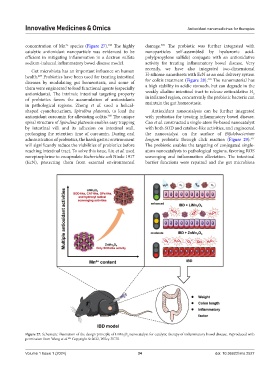
            concentration of Mn  species (Figure  27).  The highly   damage.  The probiotic was further integrated with
                             4+
                                               406
                                                                     409
            catalytic antioxidant nanoparticle was evidenced to be   nanoparticles  self-assembled  by  hyaluronic  acid-
            efficient in mitigating inflammation in a dextran sulfate   poly(propylene sulfide) conjugate with an antioxidative
            sodium-induced inflammatory bowel disease model.   activity  for  treating  inflammatory  bowel  disease.  Very
              Gut microbiota has an important influence on human   recently,  we  have  also  integrated  two-dimensional
            health.  Probiotics have been used for treating intestinal   H-silicene nanosheets with EcN as an oral delivery system
                 407
                                                                                         410
            diseases  by  modulating  gut  homeostasis,  and  some  of   for colitis treatment (Figure 28).  The nanomaterial has
            them were engineered to load functional agents (especially   a high stability in acidic stomach, but can degrade in the
            antioxidants).  The  intrinsic  intestinal  targeting  property   weakly alkaline intestinal tract to release antioxidative H
                                                                                                             2
            of probiotics favors the accumulation of antioxidants   in inflamed region, concurrently the probiotic bacteria can
            in  pathological  regions.  Zhong  et al.  used  a  helical-  maintain the gut homeostasis.
            shaped cyanobacterium,  Spirulina platensis, to load the   Antioxidant  nanocatalysts  can  be  further  integrated
            antioxidant curcumin for alleviating colitis.  The unique   with probiotics for treating inflammatory bowel disease.
                                               408
            spiral structure of Spirulina platensis enables easy trapping   Cao et al. constructed a single-atom Fe-based nanocatalyst
            by intestinal villi and its adhesion on intestinal wall,   with both SOD and catalase-like activities, and engineered
            prolonging  the  retention  time  of  curcumin.  During  oral   the nanocatalyst on the surface of  Bifidobacterium
                                                                                                            411
            administration of probiotics, the harsh gastric environment   longum probiotic through click reaction (Figure  29).
            will significantly reduce the viabilities of probiotics before   The probiotic enables the targeting of conjugated single-
            reaching intestinal tract. To solve this issue, Liu et al. used   atom nanocatalysts to pathological regions, favoring ROS
            norepinephrine to encapsulate Escherichia coli Nissle 1917   scavenging  and  inflammation  alleviation.  The  intestinal
            (EcN), protecting them from external environmental   barrier functions were repaired and the gut microbiota


            Figure 27. Schematic illustration of the design principle of LiMn O  nanocatalyst for catalytic therapy of inflammatory bowel disease. Reproduced with
                                                       4
                                                      2
            permission from Wang et al.  Copyright © 2022, Wiley-VCH.
                              406
            Volume 1 Issue 1 (2024)                         34                               doi: 10.36922/imo.2527

