


Page 43 - IMO-1-1
P. 43
Innovative Medicines & Omics                                         Antioxidant nanomedicines for therapies


            not induced by the same allergens.  When antigens enter   on  follicular  epithelial  cells.  Oxidative stress has been
                                                                                      434
                                       426
            skin, Langerhans cells recognize and present antigens to   indicated in the process of hair follicular miniaturization, by
            naive CD  T cells, initiating an inflammatory process. 427,428    initiating perifollicular inflammation and suppressing the
                   4+
            Oxidative stress also involves in this process,  which   telogen-to-anagen conversion of hair follicles.  Minoxidil
                                                   429
                                                                                                   435
            promotes the release of pro-inflammatory factors such as   is the only approved drug for treating androgenetic alopecia
            IL-1β and TNF-α that activate T cells and macrophages,   by vasodilating dermal blood vessels, but this drug cannot
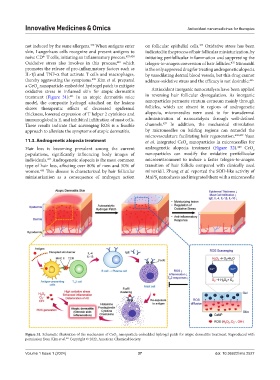
            thereby aggravating the symptoms.  Kim et al. prepared   address oxidative stress and the efficacy is not desirable. 436
                                        430
            a CeO  nanoparticle-embedded hydrogel patch to mitigate
                 2
            oxidative stress in inflamed skin for atopic dermatitis   Antioxidant inorganic nanocatalysts have been applied
                               431
            treatment (Figure  31).   In  an  atopic  dermatitis  mice   in  reversing  hair  follicular  dysregulation.  As  inorganic
            model,  the  composite  hydrogel  attached  on  the  lesions   nanoparticles permeate stratum corneum mainly through
            shows therapeutic effects of decreased epidermal   follicles, which are absent in regions of androgenetic
            thickness, lowered expression of T helper 2 cytokines and   alopecia, microneedles were used to for transdermal
            immunoglobulin E, and inhibited infiltration of mast cells.   administration  of  nanocatalysts  through  well-defined
                                                                      437
            These  results  indicate that  scavenging  ROS is  a  feasible   channels.   In  addition,  the  mechanical  stimulation
            approach to alleviate the symptoms of atopic dermatitis.  by microneedles on balding regions can remodel the
                                                               microvasculature facilitating hair regeneration. 438,439  Yuan
            11.3. Androgenetic alopecia treatment              et al. integrated CeO  nanoparticles in microneedles for
                                                                                2
                                                                                                      440
            Hair loss is becoming prevalent among the current   androgenetic  alopecia treatment (Figure  32).  CeO
                                                                                                             2
            populations,  significantly  influencing  body  images  of   nanoparticles  can  modify  the  oxidative  perifollicular
            individuals.  Androgenetic alopecia is the most common   microenvironment  to  induce  a  faster  telogen-to-anagen
                     432
            type of hair loss, affecting over 80% of men and 50% of   transition  of  hair  follicle  compared  with  clinically  used
            women.  This disease is characterized by hair follicular   minoxidil. Zhang et al. reported the SOD-like activity of
                  433
            miniaturization  as  a  consequence  of  androgen  action   MnPS  nanosheets and integrated them with a microneedle
                                                                    3


            Figure 31. Schematic illustration of the mechanism of CeO  nanoparticle-embedded hydrogel patch for atopic dermatitis treatment. Reproduced with
                                                   2
            permission from Kim et al.  Copyright © 2022, American Chemical Society.
                             431
            Volume 1 Issue 1 (2024)                         37                               doi: 10.36922/imo.2527

