


Page 42 - IMO-1-1
P. 42
Innovative Medicines & Omics                                         Antioxidant nanomedicines for therapies


            Table 8. Summary of representative antioxidant nanomedicines for the treatment of intestinal diseases
            Antioxidant nanomedicine                        Reaction type  Disease                    References
            Diselenide-bridged hyaluronic acid nanoparticle  Non-catalytic  Ulcerative colitis          399
            Zero-valent-molybdenum nanodot                  Non-catalytic  Ulcerative colitis           400
            Melanin nanoparticle                            Non-catalytic  Ulcerative colitis           401
            Quercetin-based nanoparticle                    Non-catalytic  Ulcerative colitis           402
            CeO  nanoparticles on montmorillonite           Catalytic     Ulcerative colitis            403
               2
            Pt nanoparticle in a Mn porphyrin-based MOF     Catalytic     Ulcerative colitis and Crohn’s disease  404
            Ruthenium-based MOF                             Catalytic     Ulcerative colitis            405
            LiMn O  nanocatalyst                            Catalytic     Ulcerative colitis            406
                2  4
            Hyaluronic acid-poly (propylene sulfide) nanoparticle on EcN  Non-catalytic  Ulcerative colitis  409
            H-silicene nanosheet on EcN                     Non-catalytic  Ulcerative colitis           410
            Single-atom Fe-based nanocatalyst on Bifidobacterium longum  Catalytic  Ulcerative colitis  411
            Abbreviation: MOF: Metal-organic framework

            deliver therapeutics to pathological regions.  It has been
                                               413
            demonstrated that nanoparticles can permeate stratum
            corneum through intracellular, intercellular, and follicular
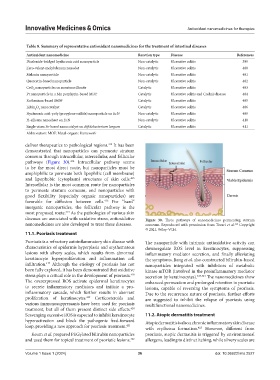
            pathways (Figure  30).   Intracellular  pathway  seems
                               414
            to be the most direct route, but nanoparticles must be
            amphiphilic to permeate both lipophilic (cell membrane)
            and  lipophobic  (cytoplasm)  structures  of  skin  cells.
                                                         415
            Intercellular is the most common route for nanoparticles
            to permeate stratum corneum, and nanoparticles with
            good flexibility (especially organic nanoparticles) are
            favorable  for  diffusion  between  cells.  For “hard”
                                             416
            inorganic nanoparticles, the follicular pathway is the
            most proposed route.  As the pathologies of various skin
                             414
            diseases are associated with oxidative stress, antioxidative   Figure  30.  Three  pathways  of nanomedicines  permeating  stratum
            nanomedicines are also developed to treat these diseases.  corneum. Reproduced with permission from Tiwari et al.  Copyright
                                                                                                     414
                                                               © 2021, Wiley-VCH.
            11.1. Psoriasis treatment
            Psoriasis is a refractory autoinflammatory skin disease with   The nanoparticle with intrinsic antioxidative activity can
            characteristics of epidermis hyperplasia and erythematous   downregulate ROS level in keratinocytes, suppressing
            lesions with silvery scales, which results from abnormal   inflammatory  mediator  secretion,  and  finally  alleviating
            keratinocyte hyperproliferation and inflammation cell   the symptoms. Jiang et al. also constructed bilirubin-based
            infiltration.   Although  the  etiology  of  psoriasis  has  not   nanoparticles integrated with inhibitors of metabolic
                     417
            been fully explored, it has been demonstrated that oxidative   kinase mTOR (involved in the proinflammatory mediator
            stress plays a critical role in the development of psoriasis.    secretion by keratinocytes). 423,424  The nanomedicines show
                                                         418
            The overexpressed ROS activate epidermal keratinocytes   enhanced permeation and prolonged retention in psoriatic
            to  secrete  inflammatory  mediators  and  initiate  a  pro-  lesions,  capable  of  reversing  the  symptoms  of  psoriasis.
            inflammatory cascade, which further results in aberrant   Due to the recurrence nature of psoriasis, further efforts
            proliferation  of  keratinocytes.  Corticosteroids and   are suggested to inhibit the relapse of psoriasis using
                                      419
            various immunosuppressants have been used for psoriasis   multifunctional nanomedicines.
            treatment,  but  all  of  them  present  distinct  side  effects.
                                                         420
            Scavenging excessive ROS is expected to inhibit keratinocyte   11.2. Atopic dermatitis treatment
            hyperactivation  and  block  the  pathogenic  feed-forward   Atopic dermatitis is also a chronic inflammatory skin disease
            loop, providing a new approach for psoriasis treatment. 421  with  erythema  formation.  However, different from
                                                                                     425
              Keum et al. prepared PEGylated bilirubin nanoparticles   psoriasis, atopic dermatitis is triggered by environmental
            and used them for topical treatment of psoriatic lesions.    allergens, leading to distinct itching, while silvery scales are
                                                         422
            Volume 1 Issue 1 (2024)                         36                               doi: 10.36922/imo.2527

