


Page 110 - IMO-2-2
P. 110
Innovative Medicines & Omics                                            Modeling Aurora-B kinase inhibitors


            Table 2. Statistical parameters of the best AADRR model
            Hypothesis ID  PLS Factor   SD       R 2     F        P       Stability  RMSE     Q 2     Pearson R
            AADRR.94          1        0.3668  0.8284   183.5   3.999 e-16  0.9384   0.357   0.804     0.8989
                              2        0.2337  0.9322   254.3   2.389 e-22  0.8595  0.2609   0.8953    0.9463
                              3        0.1547  0.9711   403     9.626 e-28  0.7662   0.245   0.9077    0.9529
            Notes: PLS: Partial least square; SD: Standard deviation of the regression; R : Coefficient of determination; F: Variance ratio; P: Significance level of
                                                            2
            the variance ratio; RMSE: Root mean square error; Q : Cross-validated correlation coefficient; Pearson R: correlation between predicted and observed
                                              2
            activity for test set.
                         A                                    B


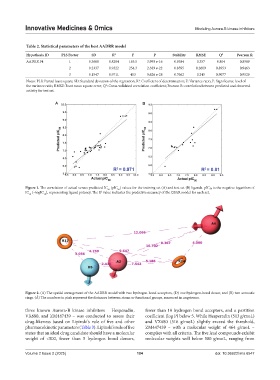
            Figure 1. The correlation of actual versus predicted IC  (pIC ) values for the training set (A) and test set (B) ligands. pIC₅₀ is the negative logarithm of
                                               50
                                                   50
            IC  (−logIC ), representing ligand potency. The R  value indicates the predictive accuracy of the QSAR model for each set.
                                            2
             50     50


            Figure 2. (A) The spatial arrangement of the AADRR model with two hydrogen-bond acceptors, (D) one hydrogen-bond donor, and (R) two aromatic
            rings. (Å) The numbers in pink represent the distances between atoms or functional groups, measured in angstroms.


            three known Aurora-B kinase inhibitors – Hesperadin,   fewer than 10 hydrogen bond acceptors, and a partition
            VX680, and ZM447439 – was conducted to assess their   coefficient (log P) below 5. While Hesperadin (513 g/moL)
            drug-likeness based on Lipinski’s rule of five and other   and VX680  (516  g/moL) slightly exceed the threshold,
            pharmacokinetic parameters (Table 3). Lipinski’s rule of five   ZM447439 – with a molecular weight of 464  g/moL –
            states that an ideal drug candidate should have a molecular   complies with all criteria. The five lead compounds exhibit
            weight of <500, fewer than 5 hydrogen bond donors,   molecular weights well below 500  g/moL, ranging from


            Volume 2 Issue 2 (2025)                        104                               doi: 10.36922/imo.6547

