


Page 112 - IMO-2-2
P. 112
Innovative Medicines & Omics                                            Modeling Aurora-B kinase inhibitors


                        A                    B                             C


                              D                             E


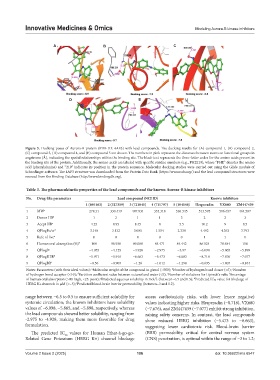
            Figure  5. Docking poses of Aurora-B protein (PDB ID: 4AF3) with lead compounds. The docking results for (A) compound 1, (B) compound 2,
            (C) compound 3, (D) compound 4, and (E) compound 5 are shown. The numbers in pink represent the distances between atoms or functional groups in
            angstroms (Å), indicating the spatial relationships within the binding site. The black text represents the three-letter codes for the amino acids present in
            the binding site of the protein. Additionally, the amino acids are labeled with specific residue numbers (e.g., PHE219), where “PHE” denotes the amino
            acid (phenylalanine) and “219” indicates its position in the protein sequence. Molecular docking studies were carried out using the Glide module of
            Schrodinger software. The 4AF3 structure was downloaded from the Protein Data Bank (https://www.rcsb.org/) and the lead compound structures were
            sourced from the Binding Database (http://www.bindingdb.org).


            Table 3. The pharmacokinetic properties of the lead compounds and the known Aurora‑B kinase inhibitors
            No.  Drug‑like parameters              Lead compound (NCI ID)                  Known inhibitors
                                      1 (695163)  2 (327359)  3 (721045)  4 (711797)  5 (104546)  Hesperadin  VX680  ZM447439
            1    MW a                  278.31   330.419  447.831  335.318   330.345   513.595  516.657  464.587
            2    Donor HB b              1        2        1         1        3         2       2        3
            3    Accpt HB  c            4.25     4.95     8.45       8       5.5       10.2     9       8.5
            4    QPlogPo/w d           3.148     3.132    3.005    1.554     2.338    4.492    4.363    3.793
            5    Rule of five e          0        0        0         0        0         1       1        0
            6    Human oral absorption (%) f  100  96.956  89.088  84.471   84.442    86.524   78.484   100
            7    QPlogS g              −4.055   −4.125   −4.928    −2.975   −3.97     −6.098   −5.865  −5.898
            8    QPlogHER h            −5.971   −5.916   −6.663    −5.473   −6.083    −8.718   −7.676  −7.077
            9    QPlogBB i             −0.56    −0.909    −1.26    −1.012   −1.298    −0.695   −1.407  −0.844
            Notes: Parameters (with their ideal values):  Molecular weight of the compound in g/mol (<500);  Number of hydrogen bond donor (<5);  Number
                                                                                                    c
                                                                          b
                                        a
            of hydrogen bond acceptor (<10);  Partition coefficient value between octanol and water (<5);  Number of violations for Lipinski’s rule;  Percentage
                                                                        e
                                  d
                                                                                                  f
            of human oral absorption (>80: high, <25: poor);  Predicted aqueous solubility in mol/L (between−6.5 and 0.5);  Predicted IC50 value for blockage of
                                            g
                                                                                    h
            HERG K+channels in µM (<−5);  Predicted blood-brain barrier permeability, (between−3 and 1.2).
                                  i
            range between −6.5 to 0.5 to ensure sufficient solubility for   assess cardiotoxicity risks, with lower (more negative)
            systemic circulation; the known inhibitors have solubility   values indicating higher risks. Hesperadin (−8.718), VX680
            values of −6.098, −5.865, and −5.898, respectively, whereas   (−7.676), and ZM447439 (−7.077) exhibit strong inhibition,
            the lead compounds showed better solubility, ranging from   raising safety concerns. In contrast, the lead compounds
            -2.975  to  -4.928,  making  them  more  favorable  for  drug   show reduced HERG inhibition (−5.473 to −6.663),
            formulation.                                       suggesting  lower  cardiotoxic  risk.  Blood-brain  barrier
              The predicted IC  values for Human Ether-à-go-go-  (BBB) permeability, critical for central nervous system
                             50
            Related Gene Potassium (HERG K+) channel blockage   (CNS) penetration, is optimal within the range of −3 to 1.2;
            Volume 2 Issue 2 (2025)                        106                               doi: 10.36922/imo.6547

