


Page 113 - IMO-2-2
P. 113
Innovative Medicines & Omics                                            Modeling Aurora-B kinase inhibitors


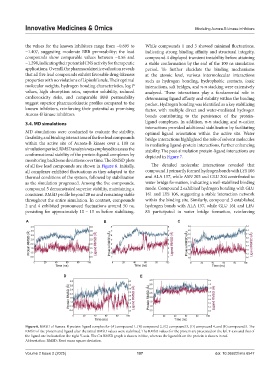
            the values for the known inhibitors range from −0.695 to   While compounds 1 and 3 showed minimal fluctuations,
            −1.407, suggesting moderate BBB permeability; the lead   indicating strong binding affinity and structural integrity,
            compounds  show  comparable  values  between  −0.56  and   compound 4 displayed transient instability before attaining
            −1.298, indicating their potential CNS activity for therapeutic   a stable conformation by the end of the 100 ns simulation
            applications. Overall, the pharmacokinetic evaluation reveals   period.  To further elucidate  the  binding  mechanisms
            that all five lead compounds exhibit favorable drug-likeness   at the atomic level, various intermolecular interactions
            properties with no violations of Lipinski’s rule. Their optimal   such as hydrogen bonding, hydrophobic contacts, ionic
            molecular weights, hydrogen bonding characteristics, log P   interactions, salt bridges, and π-π stacking were extensively
            values, high absorption rates, superior solubility, reduced   analyzed. These interactions play a fundamental role in
            cardiotoxicity risks, and comparable BBB permeability   determining ligand affinity and stability within the binding
            suggest superior pharmacokinetic profiles compared to the   pocket. Hydrogen bonding was identified as a key stabilizing
            known inhibitors, reinforcing their potential as promising   factor, with multiple direct and water-mediated hydrogen
            Aurora-B kinase inhibitors.                        bonds contributing to the persistence of the protein-
            3.4. MD simulations                                ligand complexes. In addition,  π-π stacking and  π-cation
                                                               interactions provided additional stabilization by facilitating
            MD simulations were conducted to evaluate the stability,   optimal ligand orientation within the active site. Water
            flexibility, and binding interactions of the five lead compounds   bridge interactions highlighted the role of solvent molecules
            within the active site of Aurora-B kinase over a 100 ns   in mediating ligand-protein interactions, further enhancing
            simulation period. RMSD analysis was employed to assess the   stability. The post-simulation protein-ligand interactions are
            conformational stability of the protein-ligand complexes by   depicted in Figure 7.
            monitoring backbone deviations over time. The RMSD plots
            of all five lead compounds are shown in Figure 6. Initially,   The detailed molecular interactions revealed that
            all complexes exhibited fluctuations as they adapted to the   compound 1 primarily formed hydrogen bonds with LYS 106
            thermal conditions of the system, followed by stabilization   and ALA 157, while ASN 205 and GLU 204 contributed to
            as the simulation progressed. Among the five compounds,   water bridge formation, indicating a well-stabilized binding
            compound 5 demonstrated superior stability, maintaining a   mode. Compound 2 exhibited hydrogen bonding with GLU
            consistent RMSD profile beyond 20 ns and remaining stable   161 and LYS 106, suggesting a stable interaction network
            throughout the entire simulation. In contrast, compounds   within the binding site. Similarly, compound 3 established
            2 and 4 exhibited pronounced fluctuations around 50 ns,   hydrogen bonds with ALA 157, while GLU 161 and LEU
            persisting for approximately 10 – 15 ns before stabilizing.   83 participated in water bridge formation, reinforcing

            A                                B                               C


                            D                                E


            Figure 6. RMSD of Aurora-B protein-ligand complex for (A) compound 1, (B) compound 2, (C) compound 3, (D) compound 4, and (E) compound 5. The
            RMSD of the protein and ligand after the initial RMSD values were stabilized. The RMSD values for the protein are presented on the left Y-axis and that of
            the ligand are indicated on the right Y-axis. The Cα RMSD graph is shown in blue, whereas the ligand fit on the protein is shown in red.
            Abbreviation: RMSD: Root mean square deviation.

            Volume 2 Issue 2 (2025)                        107                               doi: 10.36922/imo.6547

