


Page 111 - IMO-2-2
P. 111
Innovative Medicines & Omics                                            Modeling Aurora-B kinase inhibitors


            278.31 g/moL to 447.83 g/moL, ensuring zero violations   The number of hydrogen bond donors and acceptors
            of Lipinski’s rule.                                also plays a crucial role in drug permeability and solubility.
                                                               The hydrogen bond donor counts of Hesperadin (2),
                                                               VX680 (2), and ZM447439 (3) are within the acceptable
                                                               range. All of the lead compounds exhibited similar donor
                                                               counts, ranging between 1 and 3, further confirming their
                                                               compliance with drug-likeness criteria. For hydrogen
                                                               bond acceptors, the known inhibitors exhibit values of 8.5
                                                               – 10.2, with Hesperadin slightly exceeding the threshold;
                                                               in comparison, the lead compounds showed values of 4.25
                                                               – 8.45, all falling within the acceptable range. Lipophilicity
                                                               assessed through log P influences membrane permeability;
                                                               the known inhibitors exhibit values of 3.793 – 4.492, all
                                                               within the acceptable range (<5); the identified lead
                                                               compounds exhibited values of 1.554 – 3.148, suggesting
                                                               favorable lipophilicity while maintaining optimal solubility
                                                               and permeability.

                                                                 Oral absorption is a key determinant of bioavailability
                                                               and an  absorption percentage  >80%  is  considered
                                                               ideal. ZM447439 shows complete absorption (100%),
                                                               while VX680 and Hesperadin exhibit 78.4% and 86.5%,
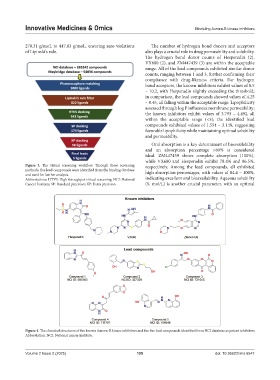
            Figure  3. The virtual screening workflow. Through these screening   respectively. Among the lead compounds, all exhibited
            methods, five lead compounds were identified from the binding database   high absorption percentages, with values of 84.4 – 100%,
            and used for further analysis.
            Abbreviations: HTVS: High throughput virtual screening; NCI: National   indicating excellent oral bioavailability. Aqueous solubility
            Cancer Institute; SP: Standard precision; XP: Extra precision.  (S, mol/L) is another crucial parameter, with an optimal


            Figure 4. The chemical structures of the known Aurora-B kinase inhibitors and the five lead compounds identified from NCI database as potent inhibitors
            Abbreviation: NCI: National cancer institute.


            Volume 2 Issue 2 (2025)                        105                               doi: 10.36922/imo.6547

