


Page 123 - ITPS-7-2
P. 123
INNOSC Theranostics and
            Pharmacological Sciences                                          PI3K-α inhibitors for cancer immunotherapy


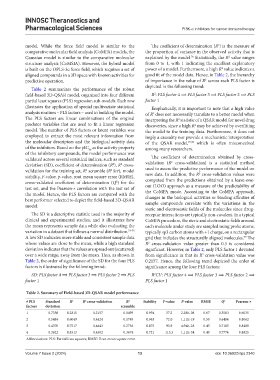
            model. While the force field model is similar to the   The coefficient of determination (R ) is the measure of
                                                                                              2
            comparative molecular field analysis (CoMFA) models, the   the proportion of variance in the observed activity that is
                                                                                                  2
            Gaussian model is similar to the comparative molecular   explained by the model.  Statistically, the R  value ranges
                                                                                  76
            structure analysis (CoMSIA). However, the hybrid model   from 0 to 1, with 1 indicating the excellent explanatory
            is built on the OPLS-3e force field, which requires a set of   power of a model. Furthermore, a high R  value indicates a
                                                                                               2
            aligned compounds in a 3D space with known activities for   good fit of the model data. Hence, in Table 2, the hierarchy
            predictive operation.                              of importance in the value of R  across each PLS factor is
                                                                                        2
                                                               depicted in the following trend:
              Table 2 summarizes the performance of the robust
                                                                   2
            field-based 3D-QSAR model, organized into four different   R : PLS factor 4 ⟹ PLS factor 3 ⟹ PLS factor 2 ⟹ PLS
            partial least squares (PLS) regression sub-models. Each row   factor 1
            illustrates the application of special multivariate statistical   Emphatically, it is important to note that a high value
            analysis routines – PLS factors – used in building the model.   of R  does not necessarily translate to a better model when
                                                                  2
            The PLS factors are linear combinations of the original   interpreting the R  statistic of a QSAR model for novel drug
                                                                             2
            predator variables that are used to fit a linear regression   discoveries, since a high R  may be achieved by overfitting
                                                                                    2
            model. The number of PLS factors or latent variables was   the model to the training data. Furthermore, it does not
            employed to extract the most relevant information from   imply a causality nor provide a mechanistic interpretation
            the molecular descriptors and the biological activity data   of the QSAR model, 77,78  which is often misconceived
            of the inhibitors. Based on the pIC  as the activity property   among many researchers.
                                       50
            of the inhibitory compounds, the model performance was
            validated across several statistical indices, such as standard   The coefficient of determination obtained by cross-
                                                                          2
            deviation (SD), coefficient of determination (R ), R  cross-  validation (R  cross-validation) is a statistical method
                                                    2
                                                 2
            validation for the training set, R  scramble (R Scr), model   used to assess the predictive performance of the model on
                                                2
                                      2
                                                                                      2
            stability, F-value, p-value, root mean square error (RMSE),   new data. In addition, the R  cross-validation values were
            cross-validated coefficient of determination (Q ) for the   computed from the predictions obtained by a leave-one-
                                                  2
            test set, and the Pearson-r correlation with the test set of   out (LOO) approach as a measure of the predictability of
            the model. Hence, the PLS factors are compared with the   the CoMFA mode. According to the CoMFA approach,
            best performer selected to depict the field-based 3D-QSAR   changes in the biological activities or binding affinities of
            model.                                             sample compounds correlate with the variations in the
                                                               steric and electrostatic fields of the molecules since drug-
              The SD is a descriptive statistic used in the majority of   receptor interactions are typically non-covalent. In a typical
            clinical and experimental studies, and it illustrates how   CoMFA procedure, the steric and electrostatic fields around
            the mean represents sample data while also evaluating the   each molecule under study are sampled using probe atoms,
            variation in a dataset that follows a normal distribution. 73-75    typically sp3 carbon atoms with +1 charge, on a rectangular
            A low SD indicates more stable and consistent sample data   grid that includes the structurally aligned molecules.  The
                                                                                                         79
            whose values are close to the mean, while a high standard   R  cross-validation value greater than 0.3 is considered
                                                                2
            deviation indicates that the values are spread out (scattered)   significant. However, in Table 2, only PLS factor 1 deviated
            over a wide range, away from the mean. Thus, as shown in   from significance in that its R  cross-validation value was
                                                                                       2
            Table 2, the order of significance of the SD for the four PLS   0.2157. Hence, the following trend depicted the order of
            factors is illustrated by the following trend:     significance among the four PLS factors:
              SD: PLS factor 4 ⟹ PLS factor 3 ⟹ PLS factor 2 ⟹ PLS   R CV: PLS factor 4 ⟹ PLS factor 3 ⟹ PLS factor 2 ⟹
                                                                   2
            factor 1                                           PLS factor 1

            Table 2. Summary of Field‑based 3D‑QSAR model performance
            # PLS   Standard   R 2  R  cross‑validation  R    Stability  F‑value  P‑value  RMSE  Q 2  Pearson‑r
                                     2
                                                        2
            factors  deviation                      scramble
            1         0.7356  0.2815     0.2157       0.0499   0.994    37.2  2.28E-08  0.67  0.3583   0.6035
            2         0.5484  0.6049     0.4424       0.1749   0.963    72.0  1.11E-19  0.50  0.6486   0.8062
            3         0.4370  0.7517     0.4643       0.2736   0.875    93.9  4.94E-28  0.45  0.7185   0.8488
            4         0.3622  0.8313     0.4502       0.3674   0.721   113.3  1.11E-34  0.40  0.7776   0.8825
            Abbreviations: PLS: Partial least squares; RMSE: Root mean square error.


            Volume 7 Issue 2 (2024)                         13                               doi: 10.36922/itps.2340

