


Page 104 - JCAU-5-2
P. 104
Journal of Chinese
            Architecture and Urbanism                                         Study on ecosystem service value in Wuhan


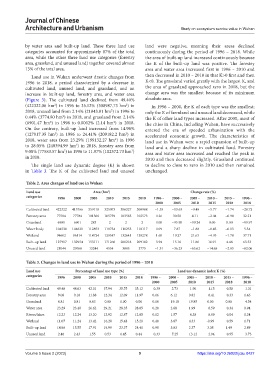
            by water area and built-up land. These three land use   land were negative, meaning their areas declined
            categories  accounted  for  approximately  87%  of  the  total   continuously during the period of 1996 – 2018. While
            area, while the other three land use categories (forestry   the area of built-up land increased continuously because
            area, grassland, and unused land) together covered almost   the K of the built-up land was positive. The forestry
            13% of the total area.                             area and water area increased first in 1996 – 2010 and
              Land use in Wuhan underwent drastic changes from   then decreased in 2010 – 2018 in that K>0 first and then
            1996  to  2018,  a  period  characterized  by  a  decrease  in   K<0. The grassland varied greatly with the largest K, and
            cultivated land, unused land, and grassland, and  an   the area of grassland approached zero in 2018, but the
            increase in built-up land, forestry area, and water area   change area was the smallest because of its minimum
            (Figure  3). The cultivated land declined from 49.40%   absolute area.
            (422322.06 hm ) in 1996 to 35.12% (300987.73 hm ) in   In 1996 – 2000, the K of each type was the smallest;
                                                       2
                        2
            2018, unused land from 2.14% (21043.81 hm ) in 1996 to   only the K of farmland and unused land decreased, while
                                                2
            0.44% (3774.80 hm ) in 2018, and grassland from 2.14%   the K of other land types increased. After 2000, most of
                            2
            (6901.47 hm ) in 1996 to 0.0002% (2.14 hm ) in 2018.   the cities in China, including Wuhan, have successively
                      2
                                                 2
            On the contrary, built-up land increased from 14.96%   entered the era of speeded urbanization with the
                                                      2
                        2
            (127917.35 hm ) in 1996 to 24.41% (209182.2 hm ) in   accelerated economic growth. The characteristics of
            2018, water area from 23.29% (199132.27 hm ) in 1996   land use in Wuhan were a rapid expansion of built-up
                                                  2
            to 28.05% (240394.99 hm ) in 2018, forestry area from   land  and  a sharp decline  in  cultivated  land.  Forestry
                                 2
            9.08% (77583.57 hm ) in 1996 to 11.97% (102572.73 hm )   area and water area increased and reached the peak in
                            2
                                                         2
            in 2018.                                           2010 and then decreased slightly. Grassland continued
              The single land use dynamic degree (K) is shown   to decline to close to zero in 2010 and then remained
            in  Table  3. The K of the cultivated land and unused   unchanged.
            Table 2. Area changes of land use in Wuhan
            Land use                     Area (hm )                               Change rate (%)
                                               2
            categories    1996  2000   2005   2010   2015   2018  1996 –   2000 –   2005 –   2010 –   2015 –   1996 –
                                                                   2000    2005   2010    2015   2018    2018
            Cultivated land  422322  415766  359118  325073  306327  300988  −1.55  −13.63  −9.48  −5.77  −1.74  −28.73
            Forestry area  77584  77784  101566  105739  103585  102573  0.26  30.58  4.11  −2.04  −0.98  32.21
            Grassland     6901  6901    283    2      2      2     0.00   −95.90  −99.24  0.00   0.00   −99.97
            Water body   104530  104621  112853  110734  110255  110117  0.09  7.87  −1.88  −0.43  −0.13  5.34
            Wetland      94602  96114  114734  139547  132641  130278  1.60  19.37  21.63  −4.95  −1.78  37.71
            Built-up land  127917  132954  153111  171266  200218  209182  3.94  15.16  11.86  16.91  4.48  63.53
            Unused land  21044  20768  13244  4554   3885   3775   −1.31  −36.23  −65.62  −14.68  −2.85  −82.06


            Table 3. Changes in land use in Wuhan during the period of 1996 – 2018
            Land use             Percentage of land use type (%)             Land use dynamic index K (%)
            categories   1996   2000   2005  2010   2015  2018   1996 –   2000 –   2005 –   2010 –   2015 –   1996 –
                                                                  2000   2005    2010    2015    2018    2018
            Cultivated land  49.40  48.63  42.01  37.94  35.75  35.12  −0.39  −2.73  −1.90  −1.15  −0.58  −1.31
            Forestry area  9.08  9.10  11.88  12.34  12.09  11.97  0.06   6.12   0.82    −0.41   −0.33   1.46
            Grassland     0.81  0.81   0.03   0.00  0.00   0.00   0.00   −19.18  −19.85  0.00    0.00   −4.54
            Water area   23.29  23.48  26.62  29.21  28.35  28.05  0.20   2.68   1.99    −0.59   −0.34   0.94
            Rivers/lakes  12.23  12.24  13.20  12.92  12.87  12.85  0.02  1.57   −0.38   −0.09   −0.04   0.24
            Wetland      11.07  11.24  13.42  16.28  15.48  15.20  0.40   3.87   4.33    -0.99   −0.59   1.71
            Built-up land  14.96  15.55  17.91  19.99  23.37  24.41  0.98  3.03  2.37    3.38    1.49    2.89
            Unused land   2.46  2.43   1.55   0.53  0.45   0.44  −0.33   −7.25   −13.12  −2.94   −0.95  −3.73


            Volume 5 Issue 2 (2023)                         9                        https://doi.org/10.36922/jcau.0427

