


Page 11 - JCTR-11-3
P. 11
Journal of Clinical and
            Translational Research                                               Lateral patellar instability in deep flexion


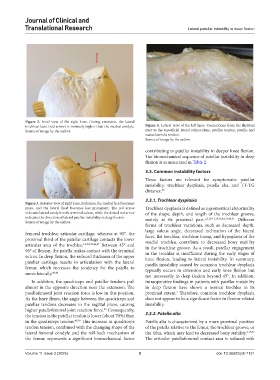
            Figure  2. Axial view of the right knee. During extension, the lateral
            trochlear facet (red arrow) is normally higher than the medial condyle.   Figure 4. Lateral view of the left knee. Connections from the iliotibial
            Source of image by the author.                     tract to the superficial lateral retinaculum, patellar tendon, patella, and
                                                               vastus lateralis tendon.
                                                               Source of image by the author.

                                                               contributing to patellar instability in deeper knee flexion.
                                                               The biomechanical sequence of patellar instability in deep
                                                               flexion is summarized in Table 2.

                                                               3.3. Common instability factors
                                                               Three factors are relevant for symptomatic patellar
                                                               instability: trochlear dysplasia, patella alta, and TT-TG
                                                               distance. 30
                                                               3.3.1. Trochlear dysplasia
            Figure 3. Anterior view of right knee. In flexion, the medial facet becomes
            more, and the lateral facet becomes less prominent. The red arrow   Trochlear dysplasia is defined as a geometrical abnormality
            indicates lateral condyle with terminal sulcus, while the dotted red arrow   of the shape, depth, and length of the trochlear groove,
            indicates the direction of lateral patellar instability in deep flexion.   mainly  at  its  proximal  part. 1,2,10-13,15,16,24,31,46,51   Different
            Source of image by the author.
                                                               forms of trochlear variations, such as decreased depth,
                                                               large sulcus angle, decreased inclination of the lateral
            femoral trochlear articular cartilage, whereas at 90°, the   facet, flat trochlea, trochlear bump, and hypoplasia of the
            proximal third of the patellar cartilage contacts the lower   medial trochlea, contribute to decreased bony stability
            articular area of the trochlea. 1,2,30,39,46,47  Between 45° and   in the trochlear groove. As a result, patellar engagement
            90° of flexion, the patella makes contact with the terminal   in the trochlea is insufficient during the early stages of
            sulcus. In deep flexion, the reduced thickness of the upper   knee flexion, leading to lateral instability. In summary,
            patellar cartilage results in articulation with the lateral   patella instability caused by common trochlear dysplasia
            femur, which increases the tendency for the patella to   typically occurs in extension and early knee flexion but
            move laterally. 46,48                              not  necessarily  in  deep  flexion beyond 45°.  In  addition,
              In addition, the quadriceps and patellar tendons pull   intraoperative findings in patients with patellar instability
            almost in the opposite direction near the extension. The   in deep flexion have shown a normal trochlea in its
            patellofemoral joint reaction force is low in this position.   proximal extent.  Therefore, common trochlear dysplasia
                                                                            2
            As the knee flexes, the angle between the quadriceps and   does not appear to be a significant factor in flexion-related
            patellar tendons decreases in the sagittal plane, causing   instability.
            higher patellofemoral joint reaction force.  Consequently,
                                             25
            the tension in the patellar tendon is lower (about 70%) than   3.3.2. Patella alta
            in the quadriceps tendon. 49,50  This increase in quadriceps   Patella alta is characterized by a more proximal position
            tendon tension, combined with the changing shape of the   of the patella relative to the femur, the trochlear groove, or
            lateral femoral condyle and the roll-back mechanism of   the tibia, which may lead to decreased bony stability. 9,16,52
            the femur, represents a significant biomechanical factor   The articular patellofemoral contact area is reduced with


            Volume 11 Issue 3 (2025)                        5                                doi: 10.36922/jctr.7131

