


Page 14 - JCTR-11-3
P. 14
Journal of Clinical and
            Translational Research                                               Lateral patellar instability in deep flexion


              Operative  treatment  for  flexion  instability  should   and subchondral quadriceps realignment) have been
            address all documented etiological  factors  and typically   recommended, particularly for treating congenital
            involve a combination of procedures. 2,5,8,64-66  Two   patellar dislocation. 4,64,67,68  A 4-in-1 quadricepsplasty,
            types of surgical reconstruction are described: (i) soft-  with or without lengthening, may be necessary in rare
            tissue reconstruction, including lateral and medial   cases with more severe forms of flexion instability to
            approaches, 3,67,68  and (ii) soft–tissue reconstruction   correct the externally rotated and shortened quadriceps
            combined with bone reconstruction, such as elevation   mechanism. 3,64,68  Z-lengthening of the quadriceps tendon
                                                                                                    68
            of the lateral femoral condyle.  Contractures of the soft   can be performed to restore its proper length.  However,
                                     2,4
            tissues lateral to the patella are among the most important   normal patellar tracking has also been reported without
                                                                                                2,64
            contributing factors and must be addressed during surgery   requiring quadriceps tendon lengthening.
            (Table  4). 5,8,69   Therefore,  lengthening  and/or  releasing  all   Biomechanically, the decreased resisting forces of the
            involved structures is the first step in the reconstruction   lateral femoral condyle are crucial in the reconstruction
            process.                                           process. 2,4,25  Any dysplastic shape of the lateral femoral
                                                               condyle, a pathologic terminal sulcus, and/or a false groove
              The role of quadriceps tendon lengthening remains a   must be corrected to restore the proper morphology
            topic of discussion.  Several quadricepsplasty techniques   according to the proximal and distal spherical morphology
                           4,64
            (i.e., sliding lengthening plasty of the lateral half of   if present. This correction is determined by the condition
            the distal quadriceps tendon, 4-in-1 quadricepsplasty,   of the soft tissue after the release of contracted structures
                                                               and the patellar  stability  during  higher  flexion. There  is
            Table 3. Pathological factors for lateral patellar instability in   a clear indication for additional bone reconstruction if
            deep flexion                                       patellar instability in flexion persists after extensive release
                                                               of the soft tissues.
            Factors (most common in combination) 2‑5,7,25,64
            Changing shapes of the lateral and medial condyle during knee flexion  3.5.1. Surgical technique
            The shape of the terminal sulcus                   The procedure is performed under tourniquet control, with
            False groove to the middle of the lateral condyle   the dislocated patella exposed through a lateral incision
            Dysplasia of the lateral femoral condyle           (Figure  9A and  B). The lateral adhesions, scar tissue
            Quadriceps contracture                             formations, tight lateral bands, iliotibial tract, and vastus
            Large quadriceps vector                            lateralis are released, and the retinacula (superficial and
            Contractures/fibrosis of lateral soft tissue structures (vastus lateralis or   deep) are incised in two layers. If lateral patellar dislocation
            iliotibial band)                                   persists  after  extensive  adhesiolysis,  appropriate  release,
            Ligamentous laxity (medial patellofemoral ligament, medial   and temporary fixation of the medial structures using a
            patellotibial ligament, and medial patellomeniscal ligament)  clamp, bone reconstruction may be necessary. The mid-
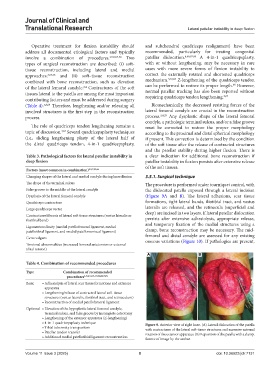
            Genu valgum                                        femoral and distal condyle are assessed for any existing
                                                               osseous variations (Figure 10). If pathologies are present,
            Torsional abnormalities (increased femoral antetorsion or external
            tibial torsion)
                                                                A                    B
            Table 4. Combination of recommended procedures

            Type            Combination of recommended
                             procedures 2‑5,8,33,35‑37,64,68,70,71
            Basic  •  Adhesiolysis of lateral scar tissue formations and extensor
                    apparatus
                   •  Lengthening/release of contracted lateral soft‑tissue
                    structures (vastus lateralis, iliotibial tract, and retinaculum)
                   •  Reconstruction of medial patellofemoral ligament
            Optional •  Elevation of the hypoplastic lateral femoral condyle,
                    terminal sulcus, and false groove by incomplete osteotomy
                   •  Lengthening of the extensor apparatus (Z‑lengthening)
                   •  4‑in‑1 quadricepsplasty technique        Figure 9. Anterior view of right knee. (A) Lateral dislocation of the patella
                   •  Tibial tuberosity transposition          with contractures of the lateral soft-tissue structures and excessive external
                   •  Patellar tendon transfer                 rotation of the extensor apparatus. (B) Reposition of the patella with a clamp.
                   •  Additional medial patellotibial ligament reconstruction
                                                               Source of image by the author.

            Volume 11 Issue 3 (2025)                        8                                doi: 10.36922/jctr.7131

