


Page 52 - JCTR-9-6
P. 52
416                       Mustahsan et al. | Journal of Clinical and Translational Research 2023; 9(6): 414-422
        randomized into two experimental groups (n = 7): (1) Untreated   sterilized in 70% ethanol and implanted into the muscle pouch,
        scaffolds and (2) decellularized scaffolds. Decellularized scaffolds   and the fascia over the muscle was sutured with resorbable sutures
        were prepared using the protocol explained in section 2.1. A set of   (Ethicon, Raritan, NJ, USA) to close the muscle wound. The skin
        untreated scaffolds which were exposed to the same reagents as   incision was closed using non-resorbable sutures (Ethicon), and
        decellularized scaffolds were also prepared, except that they do   topical  antibiotics  were  applied.  Buprenorphine  (0.1  mg/kg)
        not have any stem cells seeded onto the surface.        analgesia  (Buprenex,  Indivior,  North  Chesterfield,  VA,  USA)
                                                                was administered immediately following surgery and twice daily
        2.3. Surgical protocol
                                                                thereafter until it was judged to be no longer necessary. The skin
          For  implantation,  animals  were  anesthetized  with  isoflurane   sutures were removed 10 – 14 days after surgery. The workflow of
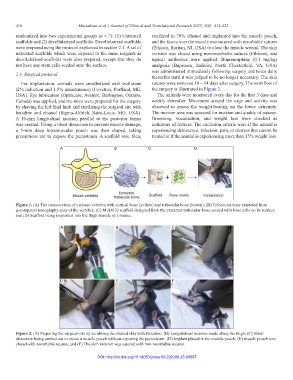
        (2% induction and 1.5% maintenance) (Covetrus, Portland, ME,   the surgery is illustrated in Figure 2.
        USA). Eye lubrication (Optixcare; Aventix, Burlington, Ontario,   The animals were monitored every day for the first 3 days and
        Canada) was applied, and the mice were prepared for the surgery   weekly  thereafter.  Movement  around  the  cage  and  activity  was
        by shaving the left hind limb and sterilizing the surgical site with   observed  to  assess  the  weight-bearing  on  the  lower  extremity.
        betadine  and  ethanol  (Sigma-Aldrich,  Saint-Louis,  MO,  USA).   The incision area was assessed for incision and quality of sutures.
        A  10-mm longitudinal  incision parallel  to the posterior femur   Grooming,  vocalization,  and  weight  loss  were  checked  as
        was created. Using a blunt dissection to prevent muscle damage,   indicators of distress. The exclusion criteria were if the animal is
        a  5-mm  deep  intramuscular  pouch  was  then  shaped,  taking   experiencing dehiscence, infection, pain, or distress that cannot be
        precautions not to expose the periosteum. A scaffold was, then,   treated or if the animal is experiencing more than 15% weight loss.

                          A                      B             C                  D


        Figure 1. (A) The cross-section of a mouse vertebra with cortical bone (yellow) and trabecular bone (brown); (B) Trabecular bone extracted from
        µ-computed tomography scan of the vertebra; (C) MED610 scaffold designed from the extracted trabecular bone seeded with bone cells on its surface;
        and (D) Scaffold being implanted into the thigh muscle of a mouse.

                          A                      B                       C


                          D                      E                       F


        Figure 2. (A) Preparing the surgical site by scrubbing the shaved skin with Betadine: (B) Longitudinal incision made along the thigh; (C) Blunt
        dissection being carried out to create a muscle pouch without exposing the periosteum; (D) Implant placed in the muscle pouch; (E) muscle pouch was
        closed with resorbable sutures; and (F) The skin incision was sutured with non-resorbable sutures.

                                          DOI: http://dx.doi.org/10.18053/jctres.09.202306.23-00097

