


Page 54 - JCTR-9-6
P. 54
418                       Mustahsan et al. | Journal of Clinical and Translational Research 2023; 9(6): 414-422
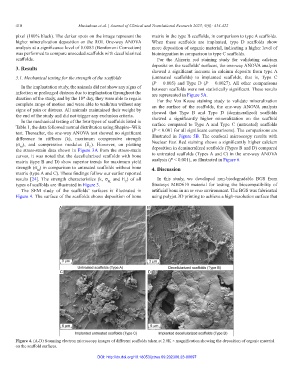
        pixel (100% black). The darker spots on the image represent the   matrix in the type B scaffolds, in comparison to type A scaffolds.
        higher mineralization deposition on the ROI. One-way ANOVA   When  these  scaffolds  are  implanted,  type  D  scaffolds  show
        analysis at a significance level of 0.0083 (Bonferroni Correction)   more deposition of organic material, indicating a higher level of
        was performed to compare unseeded scaffolds with decellularized   biointegration in comparison to type C scaffolds.
        scaffolds.                                                 For the  Alizarin red  staining  study for validating  calcium
                                                                deposits on the scaffolds’ surfaces, the one-way ANOVA analysis
        3. Results
                                                                showed  a  significant  increase  in  calcium  deposits  from  type A
        3.1. Mechanical testing for the strength of the scaffolds  (untreated  scaffolds)  to  implanted  scaffolds,  that  is,  Type  C
                                                                (P = 0.005) and  Type  D (P = 0.0027). All  other  comparisons
          In the implantation study, the animals did not show any signs of   between scaffolds were not statistically significant. These results
        infection or prolonged distress due to implantation throughout the   are represented in Figure 5A.
        duration of the study, and by the 10  day, they were able to regain   For the  Von Kossa staining  study to validate  mineralization
                                    th
        complete range of motion and were able to walk/run without any   on  the  surface  of  the  scaffolds,  the  one-way ANOVA  analysis
        signs of pain or distress. All animals maintained their weight by   showed  that  Type  B  and  Type  D  (demineralized)  scaffolds
        the end of the study and did not trigger any exclusion criteria.  showed  a  significantly  higher  mineralization  on  the  scaffold
          In the mechanical testing of the four types of scaffolds listed in
        Table 1, the data followed normal distribution using Shapiro–Wilk   surface  compared  to  Type A  and  Type  C  (untreated)  scaffolds
        test. Thereafter, the one-way ANOVA test showed no significant   (P < 0.001 for all significant comparisons). The comparisons are
        difference  in  stiffness  (k),  maximum  compressive  strength   illustrated  in  Figure  5B.  The confocal microscopy results with
        (σ ), and compressive  modulus (E ).  However,  on  plotting   Nuclear Fast Red staining shows a significantly higher calcium
         M
                                      C
        the stress-strain data shown in Figure 3A from the stress-strain   deposition in demineralized scaffolds (Types B and D) compared
        curves, it was noted that the decellularized scaffolds with bone   to untreated scaffolds (Types A and C) in the one-way ANOVA
        matrix (type B and D) show superior trends for maximum yield   analysis (P < 0.001), as illustrated in Figure 6.
        strength (σ ) in comparison to untreated scaffolds without bone   4. Discussion
                 M
        matrix (type A and C). These findings follow our earlier reported
        results  [24].  The  strength  characteristics  (k,  σ  and  E ) of all   In this study, we developed non-biodegradable  BGS  from
                                              M,
                                                     C
        types of scaffolds are illustrated in Figure 3.         Stratasys MED610 material  for testing  the biocompatibility  of
          The  SEM  study  of  the  scaffolds’  surfaces  is  illustrated  in   artificial bone in an in vivo environment. The BGS was fabricated
        Figure 4. The surface of the scaffolds shows deposition of bone   using polyjet 3D printing to achieve a high-resolution surface that
                          A                                    B


                          C                                    D


        Figure 4. (A-D) Scanning electron microscopy images of different scaffolds taken at 2.0K × magnification showing the deposition of organic material
        on the scaffold surfaces.

                                          DOI: http://dx.doi.org/10.18053/jctres.09.202306.23-00097

