


Page 53 - JCTR-9-6
P. 53
Mustahsan et al. | Journal of Clinical and Translational Research 2023; 9(6): 414-422   417
        2.4. Extraction and post-operative testing              test at a significance level of 0.0083 (Bonferroni correction) was
                                                                performed to compare the different strength characteristics of the
          After 3 weeks, the mice were euthanized with a lethal dose   various scaffolds.
        of isoflurane, and the scaffolds were extracted for post-operative   Post-compression tests, scanning electron microscopy (SEM)
        mechanical  and  staining  studies.  The  scaffolds  extracted  from   imaging (10.0 K × magnification at electron high-tension voltage
        the  animals  were  fixed  in  4%  formaldehyde  solution  for  24  h   of 3.0 kV) was performed to observe the surface of the different
        and washed and stored in DPBS for post-operative studies. The   groups of scaffolds. Thereafter, staining studies with 2% Alizarin
        previous studies have shown that pre-coating the BGS with CRFP   red to validate calcium deposits and Von Kossa staining to validate
        leads to enhanced osteoinduction which results in the deposition   mineralization on the BGS surface were conducted. The Alizarin
        of more bone matrix, contributing to improving the load-bearing   red-stained scaffolds were imaged using a confocal microscope
        capacity, that is, the compressive strength of the BGS. Therefore,   (LSM-510;  Zeiss,  Oberkochen,  Germany).  We  followed  up
        we  performed  unconstrained  mechanical  compressive  testing   these studies with histological  studies using Nuclear Fast Red
        (MTEST Quattro,  Admet,  Norwood, MA, USA) on four sets   (Kernechtrot)  staining  for calcium  and were imaged  using a
        of MED610 scaffolds (Table 1). For this purpose, the force was
        applied in the direction of the axis of the scaffold, as illustrated in   confocal  microscope  (upright  DM  6000;  Leica  Microsystems,
        Figure 3B. The speed of compression was set to 5 mm/min based on   Wetzlar,  Germany).  In  these  staining  studies,  ten  regions  of
        the ISO 604, international standards for plastics [47]. Stiffness (k),   interest (ROI) (0.7 mm × 0.7 mm) were identified for analysis
        maximum compressive strength (σ ), and compressive modulus   in each image of the stained scaffold. For Alizarin red staining
                                    M
        (E ) in the central axis were evaluated. Thereafter, Shapiro–Wilk   and Nuclear Fast Red staining, each ROI image was processed
         C
        test was carried out for the compressive test results of each type   to isolate the red-colored pixel intensity map from the Red-Blue-
        of scaffold to assess the normality of the data before carrying out   Green (RGB) color image. This red color intensity map then is
        the statistical analysis. A one-way analysis of variance (ANOVA)   normalized such that “0” is the least red (100% white) and “1” is
                                                                the value for the highest red value (100% red). Then, the average of
                                                                this normalized intensity pixel map was calculated to represent the
         Table 1. Types of MED610 scaffolds.
        Type                         Protocol                   measure of the red intensity of the ROI. The higher red intensity
                                                                measure indicates more red spots on the ROI (representing higher
         A                           Untreated scaffolds        deposition of calcium deposits). In the case of Von Kossa staining,
         B                           Decellularized scaffolds   the RGB color image was converted to a grayscale image and
         C                           Implanted untreated scaffolds  normalize the grayscale image such that the “0” value refers to the
         D                           Implanted decellularized scaffolds  brightest pixel (100% white) and “1” value refers to the darkest

                          A                                    B


                                                              C


                          D                                    E


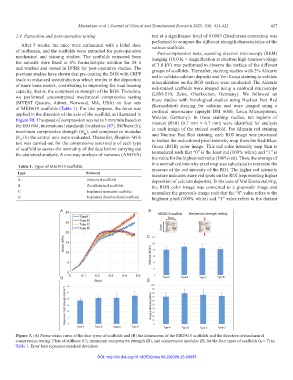
        Figure 3. (A) Stress-strain curve of the four types of scaffolds and (B) the dimensions of the MED610 scaffolds and the direction of mechanical
        compression testing. Plots of stiffness (C), maximum compressive strength (D), and compressive modulus (E) for the four types of scaffolds (n = 7) in
        Table 1. Error bars represent standard deviation.

                                          DOI: http://dx.doi.org/10.18053/jctres.09.202306.23-00097

