


Page 55 - JCTR-9-6
P. 55
Mustahsan et al. | Journal of Clinical and Translational Research 2023; 9(6): 414-422   419

                          A                                 B


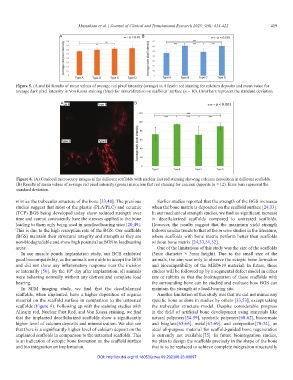
        Figure 5. (A and B) Results of mean values of average red pixel intensity (orange) in Alizarin red staining for calcium deposits and mean value for
        average dark pixel intensity in Von Kossa staining (blue) for mineralization on scaffolds’ surface (n = 10). Error bars represent the standard deviation.

                          A                              B


        Figure 6. (A) Confocal microscopy images if the different scaffolds with nuclear fast red staining showing calcium deposition in different scaffolds.
        (B) Results of mean values of average red pixel intensity (green) in nuclear fast red staining for calcium deposits (n = 12). Error bars represent the
        standard deviation.

        mimics the trabecular structure of the bone [33,48]. The previous   Earlier studies reported that the strength of the BGS increases
        studies suggest that most of the plastic (PLA/PLC) and ceramic   when the bone matrix is deposited on the scaffold surface [24,33].
        (TCP) BGS being developed today show reduced strength over   In our mechanical strength studies, we find no significant increase
        time and cannot consistently bare the stresses applied to the bone   in  decellularized  scaffolds  compared  to  untreated  scaffolds.
        leading to them only being used in non-loadbearing sites [20,49].   However,  the  results  suggest  that  the  maximum  yield  strength
        This is due to the high resorption rate of the BGS. Our scaffolds   follows similar trends to that of the in vitro studies in the literature,
        (BGS) maintain their structural integrity and strength as they are   where scaffolds with bone matrix perform better than scaffolds
        non-biodegradable and show high potential as BGS in loadbearing   without bone matrix [24,33,51,52].
        areas.                                                     One of the limitations of this study was the size of the scaffolds
          In  our  muscle  pouch  implantation  study,  our  BGS  exhibited   (3mm  diameter  ×  3mm  height).  Due  to  the  small  size  of  the
        good biocompatibility, as the animals were able to accept the BGS   animals, the aim was only to observe the ectopic bone formation
        and  did  not  show  any  inflammatory  response  near  the  incision   and biocompatibility  of the  MED610 material.  In future,  these
        or internally [50]. By the 10  day after implantation, all animals   studies will be followed up by a segmental defect model in either
                               th
        were behaving normally without any distress and complete load   rats or rabbits so that the biointegration of these scaffolds with
        bearing.                                                the surrounding bone can be studied and evaluate how BGS can
          In  SEM  imaging  study,  we  find  that  the  decellularized   maintain the strength at a load-bearing site.
        scaffolds, when implanted, have a higher deposition of organic   Another limitation of this study was that we did not mimic any
        material on the scaffold surface in comparison to the untreated   specific bone as done in studies by others [33,53], except taking
        scaffolds (Figure 4). Following up with the staining studies with   the  trabecular  structure  model.  Despite  considerable  progress
        Alizarin red, Nuclear Fast Red, and Von Kossa staining, we find   in  the  field  of  artificial  bone  development  using  materials  like
        that  the  implanted  decellularized  scaffolds  show  a  significantly   natural polymers [54-59], synthetic polymers [60-62], biocermaic
        higher level of calcium deposits and mineralization. We also see   and  bioglass [63-66],  metal [67-69],  and  composites [70-74],  an
        that there is a significantly higher level of calcium deposit on the   ideal all-purpose material for scaffold-guided bone regeneration
        implanted scaffolds in comparison to the untreated scaffolds. This   is  currently  not  available [75]. In future biointegration  studies,
        is an indication of ectopic bone formation on the scaffold surface   we plan to design the scaffolds precisely in the shape of the bone
        and bio integration on implantation.                    that is to be replaced to achieve complete integration structurally
                                          DOI: http://dx.doi.org/10.18053/jctres.09.202306.23-00097

