


Page 57 - MI-2-1
P. 57
Microbes & Immunity                                       ABO blood type and cancer risk: A complex relationship


            Table 1. (Continued)
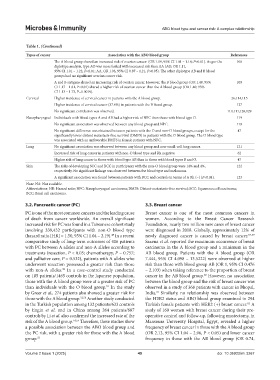
            Types of cancer                    Association with the ABO blood group                References
                        The A blood group shared an increased risk of ovarian cancer: (OR 1.09, 95% CI 1.01 – 1.18; P<0.01). As per the   108
                        diplotype analysis, type AO was more linked with increased risk than AA (AO, OR 1.11,
                        95% CI 1.01 – 1.22, P<0.01; AA, OR 1.03, 95% CI 0.87 – 1.21, P>0.05). The other diplotype AB and B blood
                        groups had no significant ovarian cancer risk.
                        A and B antigens shared an increasing risk of ovarian cancer. However, the B blood group (OR 1.48, 95%    109
                        CI 1.17 – 1.81, P<0.01) shared a higher risk of ovarian cancer than the A blood group (OR 1.40; 95%
                        CI 1.13 – 1.73, P=0.0019).
            Cervical    Higher incidence of cervical cancer in patients with the A blood group.    26,114,115
                        Higher incidence of cervical cancer (37.9%) in patients with the B blood group.  127
                        No significant correlation was observed.                                  110,111,128,129
            Nasopharyngeal Individuals with blood types A and AB had a higher risk of NPC than those with blood type O.  119
                        No significant association was observed between any blood group and NPC.      118
                        No significant difference was obtained between patients with the O and non-O blood groups, except for the   47
                        significantly lower distant metastasis-free survival (DMFS) in patients with the O blood group. The O blood type
                        was associated with an unfavorable DMFS in female patients with NPC.
            Lung        No significant association was observed between any blood group and non-small-cell lung cancer.  121
                        Increased risk of lung cancer in patients with non-O blood type and Rh negative.  62
                        Higher risk of lung cancer in those with blood type AB than in those with blood types B and O.  47
            Skin        The risks of developing SCC and BCC in participants with the non-O blood group were 14% and 4%,   122
                        respectively. No significant linkage was observed between the blood type and melanoma.
                        A significant association was found between patients with BCC and controls in terms of A Rh (−) (P<0.01).  123
            Note: NA: Not available.
            Abbreviations: HR: Hazard ratio; NPC: Nasopharyngeal carcinoma; DMFS: Distant-metastasis-free survival; SCC: Squamous cell carcinoma;
            BCC: Basal cell carcinoma.

            3.2. Pancreatic cancer (PC)                        3.3. Breast cancer
            PC is one of the most common cancers and the leading cause   Breast cancer  is one  of the  most common  cancers in
            of death from cancer worldwide. An overall significant   women. According to the Breast Cancer Research
            increased risk for PC was found in a Taiwanese cohort study   Foundation, nearly two million new cases of breast cancer
            involving 339,432 participants with non-O blood type   were diagnosed in 2018. Globally, approximately 12% of
            (hazard ratio [HR] = 1.50, 95% CI 1.04 – 2.19).  In a recent   newly  diagnosed  cancer  is  caused  by  breast  cancer. 57-59
                                                49
            comparative study of long-term outcomes of 406 patients   Saxena et al. reported the maximum occurrence of breast
            with PC between A alleles and non-A alleles according to   carcinoma in the A blood group and a minimum in the
            treatments (resection, P < 0.05; chemotherapy, P = 0.757;   AB blood group. Patients with the A blood group (OR
            and palliative care, P = 0.532), patients with A alleles who   7.444, 95% CI 4.098 – 13.5222) were observed at higher
            underwent resection possessed a greater risk than those   risk than those with blood group AB (OR 1, 95% CI 0.476
            with non-A alleles.  In a case–control study conducted   – 2.103) when taking reference to the proportion of breast
                            50
            on 185 patients/1465 controls in the Japanese population,   cancer in the AB blood group.  However, no association
                                                                                        60
            those with the A blood group were at a greater risk of PC   between the blood group and the risk of breast cancer was
            than individuals with the O blood group.  In the study   observed in a study of 368 patients with cancer in Bhopal,
                                              51
            by Greer et al., 274 patients also showed a greater risk for   India.  Similarly, no relationship was observed between
                                                                    61
            those with the A blood group. 52,53  Another study conducted   the HER2 status and ABO blood group examined in 294
            in the Turkish population among 132 patients/633 controls   Turkish female patients with HER2 (+) breast cancer.  A
                                                                                                          62
            by Engin  et al. and in China among 264  patients/687   study of 160 women with breast cancer during their pre-
            controls by Li et al. also confirmed the increased rate of the   operative control and follow-up, following mastectomy, in
            risk of the A blood group. 54,55  Therefore, these studies show   Mansoura University Hospital, Egypt, revealed a higher
            a possible association between the ABO blood group and   frequency of breast cancer in those with the A blood group
            the PC risk, with a greater risk for those with the A blood   (OR 2.13, 95% CI 1.04 – 2.96, P < 0.05) and lower cancer
            group. 56                                          frequency in those with the AB blood group (OR 0.74,


            Volume 2 Issue 1 (2025)                         49                               doi: 10.36922/mi.3267

