


Page 54 - MI-2-1
P. 54
Microbes & Immunity                                       ABO blood type and cancer risk: A complex relationship


              Numerous studies have reported associations between   galactosyltransferase, which transfers D-galactose to the
            blood types and cancer susceptibility. A  relationship   H determinant. However, the O-variant allele encodes a
            between the A blood group and gastric cancer was first   non-functional glycosyltransferase and is characterized by
            demonstrated in 1953.  Since then, a higher incidence of   a single base pair deletion at base pair 261, resulting in the
                              9
            the A blood group has been documented in numerous   loss of enzyme translation and unmodified H antigen. 18,19
            cancers, such as colon, ovarian, and cervical cancers. As   Thus, the carbohydrate moieties present on the surface
            cells become malignant, they tend to lose normal blood   of the erythrocyte’s membrane define ABO blood group
            antigens and gain new tumor-associated antigens.  The   antigens.  Besides red blood cells, the expression of ABO
                                                                      20
                                                     10
            reduction in normal antigens (A, B, and H) is inversely   antigens is also observed on the surface of various human
            proportional to the metastatic ability of the tumor.    cells and tissues, such as vascular endothelium, platelets,
                                                         11
            Some tumor antigens are true A antigens, while others are   sensory neurons, mucus secretions, and epithelial tissues. 21
            A-like antigens, sharing properties similar to A antigens.
                                                         12
            Therefore, these antigens can be detected on the tumors of   1.1.2. Immune response
            patients with blood type A, as they would be recognized as   Blood group antigens are considered primarily tissue
            foreign antigens, triggering an immune attack.  However,   antigens distributed throughout the body. The rejection
                                                 13
            A or A-like antigens present in tumors are not perceived   of transplanted organs and natural abortions is caused
            as foreign in individuals with the A blood group.  This   by antibodies produced against these antigens.  ABO
                                                     14
                                                                                                       22
            may explain why individuals with the A blood group have   antigens expressed in normal tissues have been reported
            a higher risk of cancer than those with blood group O. 15,16    to be different from those expressed in cancerous cells. 23,24
            This review attempts to decipher the correlation between   This difference is assumed to alter cell motility, apoptosis,
            the frequency of blood groups and the incidence of   and immune escape.  The ABO blood type system is linked
                                                                               25
            different cancers.                                 to several diseases including cancer in humans based on
                                                               the presence or absence of those antigens throughout the
            1.1. Mechanism of the pathology                    body. 26,27  However, the underlying phenomena associated
            1.1.1. Glycosyltransferase activity                with the risk of ABO variants with tumor development and
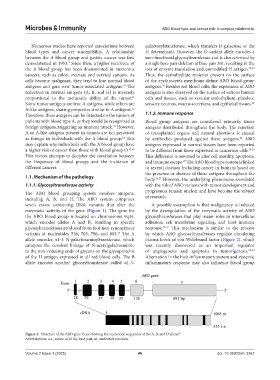
            The  ABO  blood  grouping  system  involves  antigens,   progression remain unclear and have become the subject
            including A, B, and H. The ABO system comprises    of research.
            seven exons containing DNA variants that alter the   A possible assumption is that malignancy is induced
            enzymatic activity of the gene (Figure  1). The gene for   by the dysregulation of the enzymatic activity of ABO
            the ABO blood group is located on chromosome 9q34,   glycosyltransferases that play major roles in intercellular
            which encodes alleles A and B, resulting in specific   adhesion,  cell  membrane  signaling, and  host immune
            glycosyltransferases produced from four non-synonymous   response. 28-31  This mechanism is similar to the process
            variants at nucleotides 526, 703, 796, and 803.  The A   by which ABO glycosyltransferases regulate circulating
                                                   17
            allele encodes  α1-3 N-galactosaminyltransferase, which   plasma levels of von Willebrand factor (Figure 2), which
            catalyzes  the  covalent  linkage  of  N-acetylgalactosamine   was recently discovered as an important regulator
            to the non-reducing ends of glycans on the glycoproteins   of angiogenesis and apoptosis in tumorigenesis. 32-34
            of the H antigen expressed in all red blood cells. The B   Alternation in the host inflammatory system and systemic
            allele encodes another glycosyltransferase called  α1-3-  inflammatory response may also influence blood group


            Figure 1.  Structure of the ABO gene locus showing the nucleotide sequences of the A, B, and O alleles 17
            Abbreviations: a.a., amino acid; bp, base pair; nt, nucleotide position.


            Volume 2 Issue 1 (2025)                         46                               doi: 10.36922/mi.3267

