


Page 84 - MI-2-3
P. 84
Microbes & Immunity                                              Carotene and immunity to COVID-19 vaccine


            5’-CCTAYGGGRBGCASCAG       and  reverse  primer    Agilent Technologies, USA), and a 7693A automatic liquid
            5’-GGACTACNNGGGTATCTAAT. The DNA samples           sampler (G4513A, Agilent Technologies, USA). Hydroguard
            were sent to an accredited laboratory (NovogeneAIT   FS water-resistant guard column (5 m length, 0.25 mm ID,
            Genomics, Singapore) for library preparation, sequencing,   10079, Restek, USA) was used in combination with a high
            and bioinformatics analysis.                       polarity, DB-FATWAX Ultra Inert PEG column (30 m length,
                                                               0.25  mm ID, 0.25 film thickness, G3903-63008, Agilent
            2.10.2. Bioinformatics analysis pipeline
                                                               Technologies, USA). Data were analyzed using the Enhanced
            The raw FASTQ files from sequencing were analyzed using   ChemStation software (version E.02.02.1431, Agilent, USA).
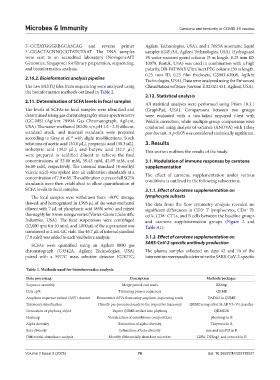
            the bioinformatics methods outlined in Table 2.
                                                               2.12. Statistical analysis
            2.11. Determination of SCFA levels in fecal samples  All statistical analyses were performed using Prism 10.3.1
            The levels of SCFAs in fecal samples were identified and   (GraphPad, USA). Comparisons between two groups
            determined using gas chromatography-mass spectrometry   were  evaluated  with  a  two-tailed  unpaired  t-test  with
            (GC-MS) (Agilent 7890A Gas Chromatograph, Agilent,   Welch’s correction, while multiple group comparisons were
            USA). The water-methanol (80:20, v/v, pH 1.5 – 2.5) diluent,   conducted using analysis of variance (ANOVA) with Tukey
            standard stock, and internal standards were prepared   post hoc test. A p<0.05 was considered statistically significant.
            according to Gray et al.  with slight modifications. Stock
                               24
            solutions of acetic acid (30.0 µL), propionic acid (30.3 µL),   3. Results
            isobutyric acid (39.0  µL), and butyric acid (32.7  µL)   This section outlines the results of the study.
            were prepared in acidified diluent to achieve the final
            concentrations of 52.60 mM, 39.43 mM, 42.05 mM, and   3.1. Modulation of immune responses by carotene
            36.80 mM, respectively. The internal standard (4-methyl   supplementation
            valeric acid) was spiked into all calibration standards at a   The effect of carotene supplementation under various
            concentration of 7.9 mM. The calibration curves of all SCFA
            standards were then established to allow quantification of   conditions is outlined in the following subsections.
            SCFA levels in fecal samples.                      3.1.1. Effect of carotene supplementation on
              The fecal samples were withdrawn from −80°C storage,   lymphocyte subsets
            thawed, and homogenized in 1,993 µL of the water-methanol   The data from the flow cytometry analysis revealed no
            diluent with 7 µL of phosphoric acid (85% w/w) and mixed   significant differences in CD3  T lymphocytes, CD4  Th
                                                                                                          +
                                                                                       +
            thoroughly for 10 min using a vortex (Vortex-Genie 2, Scientific   cells, CD8  CTLs, and B cells between the baseline groups
                                                                       +
            Industries, USA). The fecal suspensions were centrifuged   and  carotene supplementation  groups  (Figure  2  and
            (12,000 rpm for 10 min), and 1,800 µL of the supernatant was   Table A1).
            transferred to 2 mL GC vials. The 46.7 µL of internal standard
            (7.9 mM) was added to each vial before analysis.   3.1.2. Effect of carotene supplementation on
                                                               SARS-CoV-2-specific antibody production
              SCFA s were quantified using an Agilent 8890 gas
            chromatograph (G3542A, Agilent Technologies, USA)   The plasma samples collected on days 42 and 70 of the
            paired with a 5977C mass selective detector (G7077C,   intervention were used to determine the SARS-CoV-2-specific


            Table 2. Methods used for bioinformatics analysis
            Data processing                             Description                      Methods/packages
            Sequence assembly                        Merge paired-end reads                  BBMap
            Data split                             Trimming primer sequences                 QIIME
            Amplicon sequence variant (ASV) denoise  Reconstruct ASVs from noisy amplicon sequencing reads  DADA2 in QIIME
            Taxonomy classification        Classify pre-processed reads to the respective taxonomy  QIIME using silva138 AB V3–V4 classifier
            Generation of phyloseq object        Export QIIME artifact into phyloseq        QIIME2R
            Heatmap                            Visualization of microbiome compositions    pheatmap in R
            Alpha diversity                        Estimation of alpha diversity           Tidyverse in R
            Beta diversity                          Estimation of beta diversity         mia and miaViZ in R
            Differential abundance analysis    Identify differentially abundant microbes  LEfSe, DESeq2, and corncob in R


            Volume 2 Issue 3 (2025)                         76                           doi: 10.36922/MI025110021

