


Page 23 - MSAM-1-1
P. 23
Materials Science in Additive Manufacturing                Spheroidization of 304L SS powder for LPBF process


            2.2. Plasma spheroidization                        the powder type: as-received versus spheroidized. The

            An inductively coupled plasma (ICP) system, TekSphero-15   response variables were mechanical properties in terms
            (Tekna Plasma System Inc., Canada), was utilized with   of yield strength (YS), ultimate tensile strength (UTS),
            a maximum power capacity of 15 kW. The machine was   and strain at break. As shown in Figure 2, to evaluate the
            equipped with Tekna’s PN-35M induction plasma torch,   repeatability of tensile properties, 15 cubic specimens with
            operating at the 2 – 5 MHz frequency range.        10 mm edge dimension were built per powder (as-received
                                                               and spheroidized) using the Renishaw AM250 machine,
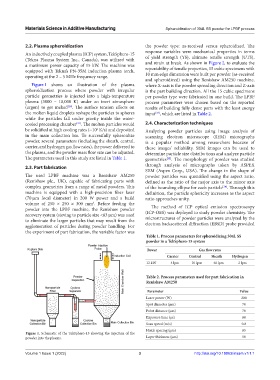
              Figure 1  shows  an illustration of  the  plasma   where X-axis is the powder spreading direction and Z-axis
            spheroidization process where powder with irregular   is the part building direction. All the 15 cubic specimens
            particle geometries is injected into a high-temperature   per powder type were fabricated in one build. The LPBF
            plasma (3000 – 10,000 K) under an inert atmosphere   process parameters were chosen based on the reported
            (argon) to get melted . The surface tension effects on   results of building fully dense parts with the least energy
                              [26]
            the molten liquid droplets reshape the particles to spheres   input , which are listed in Table 2.
                                                                   [32]
            while the particles fall under gravity inside the water-
            cooled processing chamber . The molten particles would   2.4. Characterization techniques
                                  [31]
            be solidified at high cooling rates (~10  K/s) and deposited   Analyzing powder particles using image analysis of
                                          6
            in the main collection bin. To successfully spheroidize   scanning electron microscope (SEM) micrographs
            powder, several parameters (including the sheath, central,   is a popular method among researchers because of
            carrier, and hydrogen gas flow rates), the power delivered to   these images’ reliability. SEM images can be used to
            the plasma, and the powder mass flow rate can be adjusted.   determine particle size distributions and analyze particle
            The parameters used in this study are listed in Table 1.  geometries [33] . The morphology of powder was studied

            2.3. Part fabrication                              through analysis of micrographs taken by ASPEX
                                                               SEM (Aspex Corp., USA). The change in the shape of
            The used LPBF machine was a Renishaw AM250         powder particles was quantified using the aspect ratio,
            (Renishaw plc., UK), capable of fabricating parts with   defined as the ratio of the major axis to the minor axis
            complex geometries from a range of metal powders. This   of the bounding ellipse for each particle [34] . Through this
            machine is equipped with a high-precision fiber laser   definition, the particle sphericity increases as the aspect
            (70 µm focal diameter) in 200 W power and a build   ratio approaches unity.
            volume of 250 × 250 × 300 mm . Before feeding the
                                         3
            powder  into  the  LPBF  machine,  the  Renishaw  powder   The method of ICP optical emission spectroscopy
            recovery system (sieving to particle size <63 µm) was used   (ICP-OES) was deployed to study powder chemistry. The
            to eliminate the larger particles that may result from the   microstructures of powder particles were analyzed by the
            agglomeration of particles during powder handling. For   electron backscattered diffraction (EBSD) probe provided
            the experiment of part fabrication, the variable factor was
                                                               Table 1. Process parameters for spheroidizing 304L SS
                                                               powder in a TekSphero‑15 system

                                                                Power                 Gas flow rates
                                                                        Carrier  Central   Sheath   Hydrogen
                                                               12 kW      4 lpm    10 lpm   40 lpm    2 lpm


                                                               Table 2. Process parameters used for part fabrication in
                                                               Renishaw AM250

                                                                Parameter                              Value
                                                               Laser power (W)                          200
                                                               Spot diameter (µm)                       70
                                                               Point distance (µm)                      70
                                                               Exposure time (µs)                       88
                                                               Scan speed (m/s)                         0.8
                                                               Hatch spacing (µm)                       85
            Figure 1. Schematic of the TekSphero-15 showing the injection of the
            powder into the plasma.                            Layer thickness (µm)                     50


            Volume 1 Issue 1 (2022)                         3                       http://doi.org/10.18063/msam.v1i1.1

