


Page 27 - MSAM-1-1
P. 27
Materials Science in Additive Manufacturing                Spheroidization of 304L SS powder for LPBF process


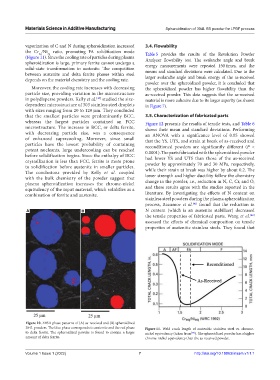
            vaporization of C and N during spheroidization increased   3.4. Flowability
            the Cr /Ni  ratio, promoting FA solidification mode   Table 5 provides the results of the Revolution Powder
                     eq
                  eq
            (Figure 11). Since the cooling rate of particles during plasma   Analyzer flowability test. The avalanche angle and break
            spheroidization is large, primary ferrite cannot undergo a   energy measurements were repeated 150 times, and the
            solid-state transformation to austenite. The competition   means and standard deviations were calculated. Due to the
            between austenite and delta ferrite phases within steel   larger avalanche angle and break energy of the as-received
            depends on the material chemistry and the cooling rate.
                                                               powder over the spheroidized powder, it is concluded that
              Moreover, the cooling rate increases with decreasing   the  spheroidized  powder  has  higher  flowability  than  the
            particle size, providing variation in the microstructure   as-received powder. This data suggests that the as-received
            in polydisperse powders. Kelly et al. [40]  studied the size-  material is more cohesive due to its larger asperity (as shown
            dependent microstructure of 303 stainless steel droplets   in Figure 7).
            with sizes ranging from 20 to 120 µm. They concluded
            that the smallest particles were predominantly BCC,   3.5. Characterization of fabricated parts
            whereas the largest particles contained an FCC     Figure 12 presents the results of tensile tests, and Table 6
            microstructure. The increase in BCC, or delta ferrite,   shows their mean and standard deviations. Performing
            with decreasing particle size, was a consequence   an ANOVA with a significance level of 0.05 showed
            of enhanced supercooling. Moreover, since small    that the YS, UTS, and strain at break of as-received and
            particles have the lowest probability of containing   reconditioned powders are significantly different (P <
            potent nucleants, large undercooling can be reached   0.0001). The parts fabricated with the spheroidized powder
            before solidification begins. Since the enthalpy of BCC   had lower YS and UTS than those of the as-received
            crystallization is less than FCC, ferrite is more prone   powder by approximately 70 and 30 MPa, respectively,
            to solidification before austenite in smaller particles.   while their strain at break was higher by about 0.2. The
            The  conclusions provided  by Kelly  et al.  coupled   lower strength and higher ductility follow the chemistry
            with the bulk chemistry of the powder suggest that
            plasma spheroidization increases the chrome-nickel   change in the powder, i.e., reduction in N, C, Cr, and O,
            equivalency of the input material, which solidifies as a   and these results agree with the studies reported in the
            combination of ferrite and austenite.              literature. By investigating the effects of N content on
                                                               stainless steel powders during the plasma spheroidization
                                                               process, Razumov  et al.  found that the reduction in
                                                                                   [41]
            A                       B                          N content (which is an austenite stabilizer) decreased
                                                               the tensile properties of fabricated parts. Wang et al.
                                                                                                           [42]
                                                               assessed the effects of chemical composition on tensile
                                                               properties of austenitic stainless steels. They found that


            Figure 10. EBSD phase patterns of (A) as-received and (B) spheroidized
            304L powders. The blue phase corresponds to austenite and the red phase   Figure 11. Weld crack length of austenitic stainless steel vs. chrome-
            to delta ferrite. The spheroidized powder is found to contain a larger   nickel equivalency (taken from ). The spheroidized powder has a higher
                                                                                  [39]
            amount of delta ferrite.                           chrome-nickel equivalency than the as-received powder.

            Volume 1 Issue 1 (2022)                         7                       http://doi.org/10.18063/msam.v1i1.1

