


Page 28 - MSAM-1-1
P. 28
Materials Science in Additive Manufacturing                Spheroidization of 304L SS powder for LPBF process


            A                                              B


                                   C


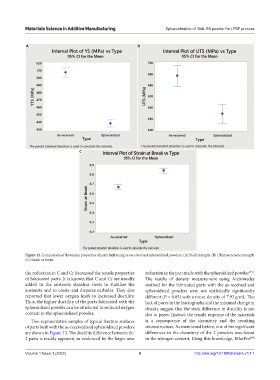
            Figure 12. Comparison of the tensile properties of parts built using as-received and spheroidized powders. (A) Yield strength. (B) Ultimate tensile strength.
            (C) Strain at break.


            the reduction in C and Cr decreased the tensile properties   reduction in the part made with the spheroidized powder .
                                                                                                           [43]
            of fabricated parts. It is known that C and Cr are usually   The results of density measurement using Archimedes
            added to the austenite stainless steels to stabilize the   method for the fabricated parts with the as-received and
            austenite and to create and disperse carbides. They also   spheroidized powders were not statistically significantly
            reported that lower oxygen leads to increased ductility.   different (P > 0.05) with a mean density of 7.93 g/mL. The
            Thus, the higher ductility of the parts fabricated with the   lack of pores in the fractographs and the minimal change in
            spheroidized powder can be attributed to reduced oxygen   density suggest that the stark difference in ductility is not
            content in the spheroidized powder.                due to pores. Instead, the tensile response of the materials
              Two representative samples of typical fracture surfaces   is a consequence of the chemistry and the resulting
            of parts built with the as-received and spheroidized powders   microstructure. As mentioned before, one of the significant
            are shown in Figure 13. The ductility difference between the   differences in the chemistry of the 2 powders was found
            2 parts is readily apparent, as evidenced by the larger area   in the nitrogen content. Using this knowledge, JMatPro
                                                                                                           [44]

            Volume 1 Issue 1 (2022)                         8                       http://doi.org/10.18063/msam.v1i1.1

