


Page 29 - MSAM-1-1
P. 29
Materials Science in Additive Manufacturing                Spheroidization of 304L SS powder for LPBF process


            simulations were performed by varying the powder’s   of the as-received and spheroidized materials predicted by
            nitrogen content to predict its influence on the material   JMatPro simulations, with the only difference being in the
            strength.  Figure 14  compares the strength and hardness   nitrogen content (as discussed in Table 4). A decrease in the
                                                               strength of material is predicted. While this difference may
            Table 5. Flowability comparison using the Revolution   not be as large as the one found in the tensile test results, the
            Powder Analyzer for as‑received and spheroidized 304L   simulations indicate that reduction in nitrogen can reduce
            powders.                                           the strength of austenitic stainless steels.

             Sample         Avalanche angle (°)  Break energy    From SEM micrographs of some cross-sections on the x-z
                                                 (mJ/kg)       plane (Figure 15) for investigating the microstructure, it can
             As-received        45.4 ± 1.5      43.2 ± 5.1     be observed that the parts built with the as-received powder
            Spheroidized        42.4 ± 0.8      28.7 ± 1.2     (Figure 15A  and  B) are mostly comprised of a cellular
                                                               microstructure all around the melt pool. However, the parts
                                                               built with spheroidized powder (Figure 15C and D) exhibit
            Table 6. Variation in mechanical properties of fabricated   cellular microstructure only at the melt pool boundaries. In
            parts with as‑received and spheroidized powders.
                                                               contrast, a sharp transition to a featureless region towards
             Property     Type           Mean     Standard     the center of the melt pool develops.
                                                  deviation
                                                                 Moreover,  as  the   chrome-nickel  equivalency
             YS (MPa)     As-received    507.27    14.55       decreased, the amount of cellular microstructure
                          Spheroidized   438.18    18.61       within the weld increased due to a shift toward primary
             UTS (MPa)    As-received    688.71    19.76       austenite solidification. Therefore, using identical process
                          Spheroidized   654.61    11.18       parameters, the proportion of cellular and featureless
                                                               regions in Figure 15 is controlled by powder chemistry. As
            Strain at break  As-received  0.66     0.044       the chrome-nickel equivalency increased, the ratio of the
                          Spheroidized    0.84      0.06       featureless phase to the cellular phase increased, hinting
            YS: Yield strength; UTS: Ultimate tensile strength.   at a change in the solidification mode. It should be noted
                                                               that the featureless and cellular phases indicate FA and
            A                      B                           AF solidification modes, respectively, as denoted in the
                                                               SEM images in  Figure 15. Therefore, the increase in the
                                                               chrome-nickel equivalency of the powder during plasma
                                                               spheroidization agrees well with the observed increase in
                                                               the part’s featureless phase. As mentioned in the previous
                                                               discussion of the particle microstructure, the decrease in
                                                               C and N caused the chrome-nickel equivalency to increase
                                                               from 1.50 to 1.74 (Table 4). Therefore, the drastic change
                                                               in the  part microstructure  results from  a change in the
                                                               powder chemistry, shifting the solidification mode from
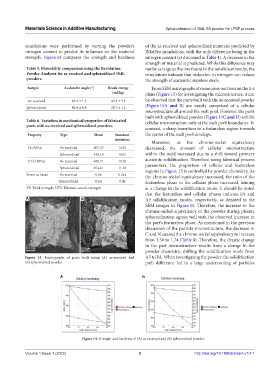
            Figure  13. Fractographs of parts built using (A) as-received and   AF to FA. When investigating the powder, the solidification
            (B) spheroidized powder.                           path difference led to a large undercooling of particles


                           A                                  B


                                    Figure 14. Strength and hardness of (A) as-received and (B) spheroidized powder.


            Volume 1 Issue 1 (2022)                         9                       http://doi.org/10.18063/msam.v1i1.1

