


Page 26 - MSAM-1-1
P. 26
Materials Science in Additive Manufacturing                Spheroidization of 304L SS powder for LPBF process


            Table 4. Bulk chemistry of as‑received and spheroidized powders.
             Type of powder                                     Element (wt%)
                               Fe      Cr      Ni      Mn      Si       C        S       O      N    Cr /Ni
                                                                                                       eq  eq
             As-received       69.9   18.28    9.04    1.27   0.56    0.015     0.005   0.027  0.07    1.50
             Spheroidized      70.0   18.18    9.41    0.83   0.56    0.008     0.004   0.024  0.03    1.74
            AISI specifications  -    18 – 20  8 – 12  2 max  1 max  0.03 max  0.03 max   -     -       -


            the solidification behavior are discussed in section  3.3
            regarding the microstructures of powder and part.

              In order to see the impact of the spheroidization process
            on the ordinary impurities in stainless steel, the oxygen and
            nitrogen  contents  of  both  as-received  and  spheroidized
            304L powders were measured using elemental evaluation
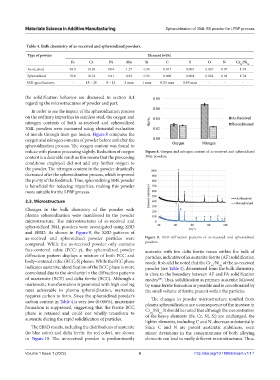
            of metals through inert gas fusion. Figure 8 compares the
            oxygen and nitrogen contents of powder before and after the
            spheroidization process. The oxygen content was found to
            reduce with plasma processing slightly. Reduction of oxygen   Figure 8. Oxygen and nitrogen content of as-received and spheroidized
            content is a desirable result as this means that the processing   304L powders.
            conditions  employed did  not add any  further  oxygen  to
            the powder. The nitrogen content in the powder drastically
            decreased after the spheroidization process, which improved
            the purity of the feedstock. Thus, spheroidizing 304L powder
            is beneficial for reducing impurities, making this powder
            more suitable for the LPBF process.

            3.3. Microstructure
            Changes in the bulk chemistry of the powder with
            plasma spheroidization were manifested in the powder
            microstructure. The microstructures of as-received and
            spheroidized 304L powders were investigated using XRD
            and EBSD. As shown in  Figure 9, the XRD patterns of
            as-received and spheroidized powder particles were   Figure 9. XRD diffraction patterns of as-received and spheroidized
            compared. While the as-received powder only contains   powders.
            face-centered cubic (FCC;  γ), the spheroidized powder   austenite with few delta ferrite traces within the bulk of
            diffraction pattern displays a mixture of both FCC and   particles, indicative of an austenite-ferrite (AF) solidification
            body-centered cubic (BCC; δ) phases. While the FCC phase   mode. It should be noted that the Cr /Ni  of the as-received
                                                                                           eq
                                                                                              eq
            indicates austenite, identification of the BCC phase is more   powder (see Table 4), determined from the bulk chemistry,
            convoluted due to the similarity in the diffraction patterns   is close to the boundary between AF and FA solidification
            of martensite (BCT) and delta ferrite (BCC). Although a   modes . Thus, solidification as primary austenite followed
                                                                    [39]
            martensitic transformation is promoted with high cooling   by some ferrite formation is possible and is corroborated by
            rates achievable in plasma spheroidization, martensite   the small volume of ferrite present within the particles.
            requires carbon to form. Since the spheroidized powder’s
            carbon content in Table 4 is very low (0.008%), martensite   The changes in powder microstructure resulted from
            formation is suppressed, suggesting that the ferrite BCC   plasma spheroidization are a consequence of the increase in
                                                               Cr /Ni . It should be noted that although the concentration
            phase is retained and could not wholly transform to   of the heavy elements (Fe, Cr, Ni, Si) are unchanged, the
                                                                 eq
                                                                     eq
            austenite during the rapid solidification of particles.
                                                               lighter elements, including C and N, decrease substantially.
              The EBSD results, including the distributions of austenite   Since C and N are potent austenitic stabilizers, even
            (in blue color) and delta ferrite (in red color), are shown   minor deviations in the concentrations of both alloying
            in  Figure 10.  The  as-received  powder  is  predominantly   elements can lead to vastly different microstructures. Thus,

            Volume 1 Issue 1 (2022)                         6                       http://doi.org/10.18063/msam.v1i1.1

