


Page 25 - MSAM-1-1
P. 25
Materials Science in Additive Manufacturing                Spheroidization of 304L SS powder for LPBF process


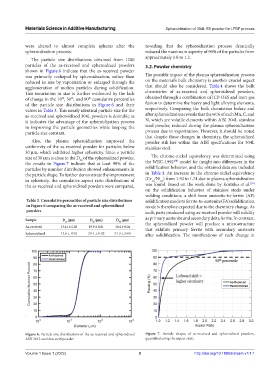
            were altered to almost complete spheres after the   revealing  that  the  spheroidization  process  drastically
            spheroidization process.                           reduced the maximum asperity of 90% of the particles from
              The particle size distributions obtained from 1200   approximately 1.8 to 1.2.
            particles of the as-received and spheroidized powders   3.2. Powder chemistry
            shown in  Figure 6 indicate that the as-received powder
            was primarily reshaped by spheroidization, rather than   The possible impact of the plasma spheroidization process
            reduced in size by vaporization or enlarged through the   on the material’s bulk chemistry is another crucial aspect
            agglomeration  of  molten  particles  during  solidification.   that should also be considered.  Table 4 shows the bulk
            This invariation in size is further evidenced by the lack   chemistries  of  as-received  and  spheroidized  powders,
            of change in the 10 , 50 , and 90  cumulative percentiles   obtained through a combination of ICP-OES and inert gas
                           th
                                       th
                               th
            of the particle size distributions in  Figure 6 and their   fusion to determine the heavy and light alloying elements,
            values in Table 3. This nearly identical particle size for the   respectively. Comparing the bulk chemistries before and
            as-received and spheroidized 304L powders is desirable as   after spheroidization reveals that the wt% of each Mn, C, and
            it indicates the advantage of the spheroidization process   N, which are volatile elements within AISI 304L stainless
            in  improving  the  particle  geometries  while  keeping  the   steel powder, reduced during the plasma spheroidization
            particle size constant.                            process due to vaporization. However, it should be noted
                                                               that despite these changes in chemistry, the spheroidized
              Also, the plasma spheroidization improved the    powder still lies within the AISI specifications for 304L
            uniformity of the as-received powder for particles below   stainless steel.
            30 µm, which exhibited higher sphericity. Since a particle
            size of 30 µm is close to the D  of the spheroidized powder,   The chrome-nickel equivalency was determined using
                                   90
                                                                           [38]
            the results in  Figure 7 indicate that at least 90% of the   the WRC-1992  model for insight into differences in the
            particles by number distribution showed enhancements in   solidification behavior, and the obtained data are included
            the particle shape. To further demonstrate the improvement   in Table 4. An increase in the chrome-nickel equivalency
            in sphericity, the cumulative aspect ratio distributions of   (Cr /Ni ) from 1.50 to 1.74 due to plasma spheroidization
                                                                     eq
                                                                  eq
                                                                                                           [39]
            the as-received and spheroidized powders were compared,   was found. Based on the work done by Korinko et al.
                                                               on the solidification behavior of stainless steels under
                                                               welding conditions, a shift from austenite-to-ferrite (AF)
            Table 3. Cumulative percentiles of particle size distributions   solidification mode to ferrite-to-austenite (FA) solidification
            in Figure 6 comparing the as‑received and spheroidized   mode is therefore expected due to the chemistry change. As
            powders                                            such, parts produced using as-received powder will solidify
            Sample          D  (µm)    D  (µm)    D  (µm)      as primary austenite and secondary delta ferrite. In contrast,
                             10         50          90         the spheroidized powder will produce a microstructure
            As-received    13.41 ± 0.03  19.9 ± 0.01  30.4 ± 0.04
                                                               that exhibits primary ferrite with secondary austenite
            Spheroidized   13.6 ± 0.02  20.4 ± 0.02  31.3 ± 0.06  after solidification. The ramifications of such change in


            Figure 6. Particle size distributions of the as-received and spheroidized   Figure 7. Particle shapes of as-received and spheroidized powders,
            AISI 304L stainless steel powder.                  quantified using the aspect ratio.


            Volume 1 Issue 1 (2022)                         5                       http://doi.org/10.18063/msam.v1i1.1

