


Page 30 - MSAM-1-1
P. 30
Materials Science in Additive Manufacturing                Spheroidization of 304L SS powder for LPBF process


            A                        B                         with the as-received powder. The more spherical geometry of
                                                               the spheroidized powder improved the powder’s flowability
                                                               compared to the as-received powder.

                                                               Acknowledgments
                                                               This work was funded by Honeywell Federal Manufacturing
                                                               & Technologies LLC under Contract No. DE-NA0002839
                                                               with the U.S. Department of Energy. The publisher, by
                                                               accepting the article for publication, acknowledges that the
            C                        D                         United States Government retains a nonexclusive, paid-up,
                                                               irrevocable, worldwide license to publish or reproduce the
                                                               published form of this manuscript, or allow others to do so,
                                                               for the United States Government purposes.
                                                               Conflict of interest

                                                               The authors declare that they have no conflict of interest.
                                                               Author contributions
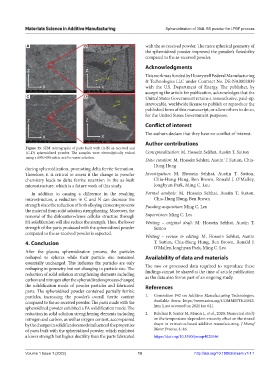
            Figure 15. SEM micrographs of parts built with (A-B) as-received and
            (C-D) spheroidized powder. The samples were electrolytically etched   Conceptualization: M. Hossein Sehhat, Austin T. Sutton
            using a 60%/40% nitric acid to water solution.
                                                               Data curation: M. Hossein Sehhat, Austin T. Sutton, Chia-
                                                                  Hung Hung
            during spheroidization, promoting delta ferrite formation.
            Therefore, it is critical to assess if the change in powder   Investigation:  M.  Hossein  Sehhat,  Austin  T. Sutton,
            chemistry leads to delta ferrite retention in the as-built   Chia-Hung Hung, Ben Brown, Ronald J. O’Malley,
            microstructure, which is a future work of this study.  Jonghyun Park, Ming C. Leu

              In addition to causing a difference in the resulting   Formal analysis: M. Hossein Sehhat, Austin T. Sutton,
            microstructure, a reduction in C and N can decrease the   Chia-Hung Hung, Ben Brown
            strength since the reduction of both alloying elements prevents   Funding acquisition: Ming C. Leu
            the material from solid solution strengthening. Moreover, the
            removal of the dislocation-dense cellular structure through   Supervision: Ming C. Leu
            FA solidification will also reduce the strength. Thus, the lower   Writing – original draft: M. Hossein Sehhat, Austin T.
            strength of the parts produced with the spheroidized powder   Sutton
            compared to the as-received powder is expected.
                                                               Writing – review & editing: M. Hossein Sehhat, Austin
            4. Conclusion                                         T. Sutton, Chia-Hung Hung, Ben  Brown, Ronald J.
                                                                  O’Malley, Jonghyun Park, Ming C. Leu
            After the plasma spheroidization process, the particles
            reshaped to spheres while their particle size remained   Availability of data and materials
            essentially unchanged. This indicates the particles are only
            reshaping in geometry but not changing in particle size. The   The raw or processed data required to reproduce these
            reduction of solid solution strengthening elements including   findings cannot be shared at the time of article publication
            carbon and nitrogen after the spheroidization process changed   as the data also forms part of an ongoing study.
            the solidification mode of powder particles and fabricated   References
            parts. The spheroidized powder contained partially ferritic
            particles, increasing the powder’s overall ferrite content   1.   Committee F42 on Additive Manufacturing Technologies.
            compared to the as-received powder. The parts made with the   Available from: https://www.astm.org/COMMITTEE/F42.
            spheroidized powder exhibited a FA solidification mode. The   htm [Last accessed on 2021 Jan 02].
            reduction in solid solution strengthening elements including   2.   Behdani B, Senter M, Mason L, et al., 2020, Numerical study
            nitrogen and carbon, as well as oxygen content, accompanied   on the temperature-dependent viscosity effect on the strand
            by the changes in solidification mode influenced the properties   shape in extrusion-based additive manufacturing. J Manuf
            of parts built with the spheroidized powder, which exhibited   Mater Process, 4: 46.
            a lower strength but higher ductility than the parts fabricated      https://doi.org/10.3390/jmmp4020046


            Volume 1 Issue 1 (2022)                         10                      http://doi.org/10.18063/msam.v1i1.1

