


Page 44 - MSAM-1-1
P. 44
Materials Science in Additive Manufacturing                    Crack-free AA7075 with Zr modification via LPBF


            A                                                B


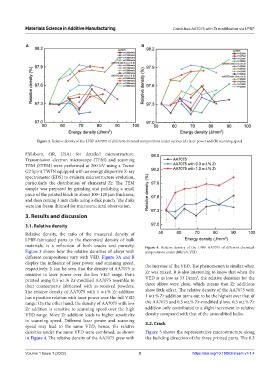
                 Figure 3. Relative density of the LPBF AA7075 of different chemical compositions under various (A) laser power and (B) scanning speed.

            Hillsboro, OR, USA) for detailed microstructure.
            Transmission electron microscope (TEM) and scanning
            TEM (STEM) were performed at 200 kV using a Tecnai
            G2 Spirit TWIN equipped with an energy dispersive X-ray
            spectrometer (EDS) to evaluate microstructure evolution,
            particularly the distribution of elemental Zr. The TEM
            sample was prepared by grinding and polishing a small
            piece of the printed block to about 100–120 μm thickness,
            and then cutting 3 mm disks using a disk punch. The disks
            were ion-beam thinned for microstructural observation.
            3. Results and discussion

            3.1. Relative density
            Relative density, the ratio of the measured density of
            LPBF-fabricated  parts  to  the  theoretical  density  of  bulk
            materials, is  a reflection of  both cracks and  porosity.   Figure  4.  Relative density of the LPBF AA7075 of different chemical
            Figure  3 shows how the relative densities of alloys with   compositions under different VED.
            different compositions vary with VED. Figure 3A and B
            display the influence of laser power and scanning speed,
            respectively. It can be seen that the density of AA7075 is   the increase of the VED. The phenomenon is similar when
            sensitive to laser power over the low VED range. Parts   Zr was mixed. It is also interesting to know that when the
                                                                                     3
            printed using 0.3 w.t.% Zr-modified AA7075 resemble to   VED is as low as 53 J/mm , the relative densities for the
            their counterparts fabricated with as-received powders.   three alloys were close, which means that Zr additions
            The relative density of AA7075 with 1 w.t.% Zr addition   show little effect. The relative density of the AA7075 with
            has a positive relation with laser power over the full VED   1 w.t.% Zr addition turns out to be the highest over that of
            range. On the other hand, the density of AA7075 with low   the AA7075 and 0.3 w.t.% Zr-modified alloys. 0.3 w.t.% Zr
            Zr addition is sensitive to scanning speed over the high   addition only contributed to a slight increment in relative
            VED range. More Zr addition leads to higher sensitivity   density compared with that of the unmodified bulks.
            to scanning speed. Different laser power and scanning   3.2. Crack
            speed may lead to the same VED; hence, the relative
            densities under the same VED were combined, as shown   Figure 5 shows the representative microstructure along
            in Figure 4. The relative density of the AA7075 grew with   the building direction of the three printed parts. The 0.3


            Volume 1 Issue 1 (2022)                         5                      https://doi.org/10.18063/msam.v1i1.4

