


Page 47 - MSAM-1-1
P. 47
Materials Science in Additive Manufacturing                    Crack-free AA7075 with Zr modification via LPBF


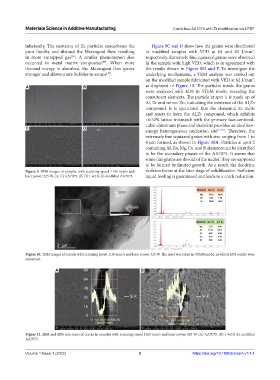
            inherently. The existence of Zr particles exacerbates the   Figure 9C and D show how the grains were distributed
            poor  fluidity and distract the  Marangoni flow, resulting   in  modified  samples  with  VED  at  64 and  82  J/mm ,
                                                                                                            3
            in more entrapped gas . A  similar phenomenon also   respectively. Extremely fine equiaxed grains were observed
                               [36]
            occurred in metal matrix composites . When more    in the sample with high VED, which is in agreement with
                                            [39]
            thermal energy is absorbed, the Marangoni flow grows   the results shown in Figure 8M and P. To investigate the
            stronger and allows more bubbles to escape .       underlying mechanisms, a TEM analysis was carried out
                                              [40]
                                                               on the modified sample fabricated with VED at 82 J/mm ,
                                                                                                            3
            A                       B                          as displayed in Figure 10. The particles inside the grains
                                                               were analyzed with EDS in STEM mode, revealing the
                                                               constituent elements. The particle at spot 1 is made up of
                                                               Al, Zr and minor Zn, indicating the existence of the Al Zr
                                                                                                           3
                                                               compound. It is speculated that the elemental Zr melts
                                                               and reacts to form the Al Zr compound, which exhibits
                                                                                    3
                                                               <0.52% lattice mismatch with the primary face-centered-
                                                               cubic aluminum phase and therefore provides an ideal low-
            C                       D
                                                               energy heterogeneous nucleation site [17,41] . Therefore, the
                                                               extremely fine equiaxed grains with size ranging from 1 to
                                                               4 μm formed, as shown in Figure 10A. Particles at spot 2
                                                               containing Al, Zn, Mg, Cu, and Si elements can be identified
                                                               to be the secondary phases of the AA7075. It seems that
                                                               some fine grains are devoid of the nuclei. They are supposed
                                                               to be formed by limited growth. As a result, the dendritic
            Figure 9. SEM images of samples with scanning speed 1100 mm/s and   skeleton forms at the later stage of solidification. Sufficient
            laser power 325 W. (A, C) AA7075. (B, D) 1 w.t.% Zr-modified AA7075.  liquid feeding is guaranteed and leads to a crack reduction.


            Figure 10. TEM images of sample with scanning speed 1100 mm/s and laser power 325 W. The inset was taken in STEM mode, in which EDS results were
            measured.

                         A                                   B


            Figure 11. SEM and EDS line scans of cracks in samples with scanning speed 1100 mm/s and laser power 325 W. (A) AA7075. (B) 1 w.t.% Zr modified
            AA7075.


            Volume 1 Issue 1 (2022)                         8                      https://doi.org/10.18063/msam.v1i1.4

