


Page 46 - MSAM-1-1
P. 46
Materials Science in Additive Manufacturing                    Crack-free AA7075 with Zr modification via LPBF


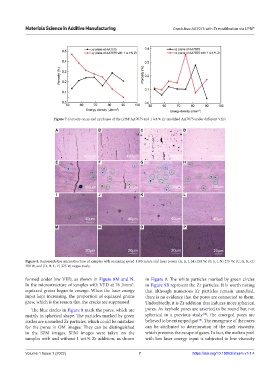
                        Figure 7. Porosity on xz and xy planes of the LPBF AA7075 and 1 w.t.% Zr-modified AA7075 under different VED.

                         A                 B                 C                 D


                         E                 F                 G                 H


                         I                 J                 K                 L


                        M                  N                 O                 P


            Figure 8. Representative microstructure of samples with scanning speed 1100 mm/s and laser power (A, E, I, M) 250 W, (B, F, J, N) 275 W, (C, G, K, O)
            300 W, and (D, H, L, P) 325 W, respectively.

            formed under low VED, as shown in Figure 8M and N.   in Figure 9. The white particles marked by green circles
            In the microstructure of samples with VED at 76 J/mm ,   in Figure 9B represent the Zr particles. It is worth noting
                                                         3
            equiaxed grains began to emerge. When the laser energy   that although numerous Zr particles remain unmelted,
            input kept increasing, the proportion of equiaxed grains   there is no evidence that the pores are connected to them.
            grew, which is the reason that the cracks are suppressed.  Undoubtedly, it is Zr addition that induces more spherical

              The blue circles in Figure 8 mark the pores, which are   pores. As keyhole pores are asserted to be round but not
                                                                                       [14]
            mainly in spherical shape. The particles marked by green   spherical in a previous study , the emerged pores are
                                                                                     [38]
            circles are unmelted Zr particles, which could be mistaken   believed to be entrapped gas . The emergence of the pores
            for the pores in OM images. They can be distinguished   can be attributed to deterioration of the melt viscosity,
            in the SEM images. SEM images were taken on the    which prevents the escape of gases. In fact, the molten pool
            samples with and without 1 w.t.% Zr addition, as shown   with low laser energy input is subjected to low viscosity


            Volume 1 Issue 1 (2022)                         7                      https://doi.org/10.18063/msam.v1i1.4

