


Page 10 - MSAM-3-3
P. 10
Materials Science in Additive Manufacturing                        Multi-material Ti6Al4V-B4C through L-DED


              Microhardness  was  measured  using  a  Phase  II  Plus   location on either side of the cylinder (Figure  2A). The
            Micro Vickers Hardness Tester (Phase II Plus, USA). The   Ti64-B4C samples exhibited reduced porosity at the
            hardness indents were made in the side cross-section for   borders  of  the  melt  pool  (Figure  3A).  The  RC  samples
            all samples with a load of 200 g and a dwell time of 15 s.   displayed significant porosity concentrated in the Ti64
            For the monolithic samples, indents were made along   core of the composite and at the interface (Figure 5). In
            the center of the sample, progressing upward in the build   addition, cracks were observed in the multi-material
            direction, with 10 points recorded. A  grid pattern was   structure at the external portion of section A-A of the
            applied on the RC cylinder, starting from the outer edge of   cylinder. Notably, our observation indicates that the B4C
            the sample and moving toward the center in a 5 × 5.5 mm   particles tend to float to the surface of the melt pool in
            grid, with data points collected at approximately 0.5 mm   the Ti64-B4C cylinders, consistent with their location
            intervals, while avoiding the B4C particles.       within the structure (Figure 3A). This is also observed for
                                                               the Ti64-B4C shell of the RC samples (Figure 5). It would
            3. Results                                         appear that particle impregnation occurred as there is

            It was hypothesized that a multi-material structure   an observable reaction zone interface between the B4C
            comprising a Ti64 core and Ti64-B4C shell would exhibit   particles and the Ti64 matrix (Figure 6D). Diffusion of the
            synergistic compression behavior by outperforming   particle’s constituents into the Ti64 matrix is evident from
            monolithic structures. In the current study, DED   the change in the microstructure of the matrix, resembling
            samples  of  Ti64  and  Ti64-B4C  were  produced,  and   acicular α-Ti, and also in the newly formed needle phase
            characterization was conducted through optical imaging   near the reaction zone of the particles (e.g., clusters
            of the microstructure evolution, XRD of the control and   throughout the matrix) (Figure  6). With EDS mapping
            treated samples for phase analysis, Vickers microhardness,   (Figure 6B), the Ti64 matrix displays minimal changes in
            and compression testing of cylindrical structures.  the matrix to Ti, Al, and V at the interface between the
                                                               first annular ring and the core of the RC structures. The
            3.1. Microstructure and phase analysis             size of the α-Ti grains changes between Ti64 and Ti64-B4C
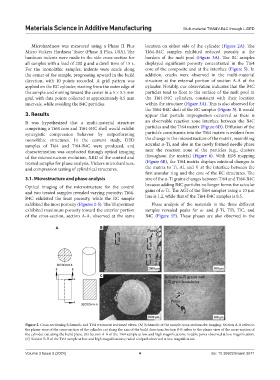
            Optical imaging of the microstructure for the control   because adding B4C particles no longer forms the acicular
            and two treated samples revealed varying porosity; Ti64-  gains of α-Ti. The AGI of the Ti64 samples using a 10 µm
            B4C exhibited the least porosity, while the RC sample   line is 1.2, while that of the Ti64-B4C samples is 0.5.
            exhibited the most porosity (Figures 2-5). The Ti specimen   Phase  analysis  of the materials  in  the three different
            exhibited maximum porosity toward the exterior portion   samples revealed peaks for  α-  and  β-Ti, TiB, TiC, and
            of the cross-section, section A-A, observed at the same   B4C (Figure  5F). These phases are also observed in the


                         A                  B


                                            C


            Figure 2. Cross-sectioning Schematic and Ti64 treatment sectioned views. (A) Schematic of the sample cross-sections for imaging: Section A-A refers to
            the planer view of the cross-section of the cylinder cut along the axis of the build direction; Section B-B refers to the planer view of the cross-section of
            the cylinder cut along the build plane. (B) Section A-A of the Ti64 sample at low and high magnifications; notable pores observed at low magnification.
            (C) Section B-B of the Ti64 sample at low and high magnifications; radial toolpath observed at low magnification.


            Volume 3 Issue 3 (2024)                         4                              doi: 10.36922/msam.3571

