


Page 14 - MSAM-3-3
P. 14
Materials Science in Additive Manufacturing                        Multi-material Ti6Al4V-B4C through L-DED


                         A             C                    D


                                                            E
                         B


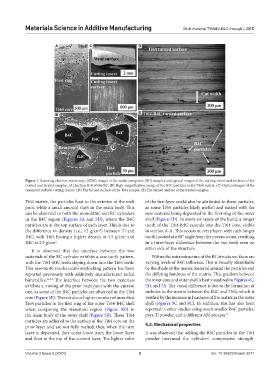
            Figure 7. Scanning electron microscope (SEM) images of the radial composite (RC) samples and optical images of the cutting insert and surfaces of the
            control and treated samples. (A) Section B-B of the RC. (B) High-magnification image of the B4C particles in the Ti64 matrix. (C) Optical images of the
            cemented carbide-cutting inserts. (D) The turned surface of the Ti64 sample. (E) The turned surface of the treated samples.

            Ti64 matrix, the particles float to the exterior of the melt   of the first layer could also be attributed to these particles,
            pool, while a small amount stays in the main body. This   as some Ti64 particles likely melted and mixed with the
            can be observed in both the monolithic and RC cylinders   new material being deposited in the first ring of the outer
            in the B4C region (Figures 3A and 5D), where the B4C   shell (Figure 5D). In every six layers of the build, a longer
            particles are at the top surface of each layer. This is due to   tooth of the Ti64-B4C extends into the Ti64 core, visible
            the difference in density (i.e., <2 g/cm ) between Ti and   in section A-A. This occurs at every layer, with each longer
                                           3
            B4C, with Ti64 having a higher density at 4.5 g/cm  and   tooth located at a 60° angle from the previous one, resulting
                                                      3
            B4C at 2.5 g/cm .                                  in a three-layer difference between the two teeth seen on
                         3
              It  is observed that the  interface between  the  two   either side of the structure.
            materials of the RC cylinder exhibits a saw-tooth pattern,   Within the microstructure of the RC structures, there are
            with the Ti64-B4C teeth sloping down into the Ti64 teeth.   varying levels of B4C influence. This is visually identifiable
            This saw-tooth mechanical-interlocking pattern has been   by the shade of the matrix material around the particles and
            reported previously with additively manufactured radial   the differing hardness of the matrix. This gradient between
            bimetallics. 11,12  The interface between the two materials   the inner core and outer shell is best visualized in Figures 4C,
            exhibits a mixing of the prior melt pool with the current   5D, and 7A. The visual difference is due to the formation of
            one, as some of the B4C particles are observed in the Ti64   carbides in the matrix between the B4C and Ti64, which is
            core (Figure 5F). There is also a higher number of unmelted   verified by the increase in hardness of the matrix in the outer
            Ti64 particles in the first ring of the outer Ti64-B4C shell   shell (Figures 5C and 8C). In addition, this has also been
            when  comparing  the  transition  region  (Figure  5D)  to   reported in other studies using much smaller B4C particles,
            the main body of the outer shell (Figure 5B). These Ti64   pure Ti powder, and a different AM process. 15
            particles are adhered to the surface of the Ti64 core on the
            prior layer and are not fully melted; thus, when the next   4.2. Mechanical properties
            layer is deposited, they come loose from the lower layer   It was observed that adding the B4C particles to the Ti64
            and float to the top of the current layer. The lighter color   powder  increased  the  cylinders’  compressive  strength,


            Volume 3 Issue 3 (2024)                         8                              doi: 10.36922/msam.3571

