


Page 13 - MSAM-3-3
P. 13
Materials Science in Additive Manufacturing                        Multi-material Ti6Al4V-B4C through L-DED


                             A                B                C                D


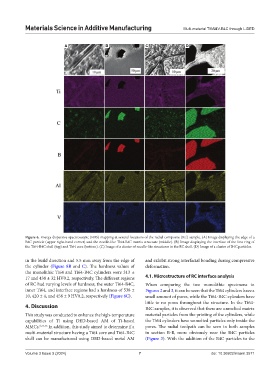
            Figure 6. Energy dispersive spectroscopic (EDS) mapping at several locations of the radial composite (RC) sample. (A) Image displaying the edge of a
            B4C particle (upper right-hand corner) and the needle-like Ti64-B4C matrix structure (middle). (B) Image displaying the interface of the first ring of
            the Ti64-B4C shell (top) and Ti64 core (bottom). (C) Image of a cluster of needle-like structures in the RC shell. (D) Image of a cluster of B4C particles.

            in the build direction and 5.5 mm away from the edge of   and exhibit strong interfacial bonding during compressive
            the cylinder (Figure  8B  and  C). The hardness values of   deformation.
            the monolithic Ti64 and Ti64-B4C cylinders were 313 ±
            17 and 438 ± 32 HV0.2, respectively. The different regions   4.1. Microstructure of RC interface analysis
            of RC had varying levels of hardness; the outer Ti64-B4C,   When comparing the two monolithic specimens in
            inner Ti64, and interface regions had a hardness of 538 ±   Figures 2 and 3, it can be seen that the Ti64 cylinders have a
            10, 420 ± 4, and 458 ± 9 HV0.2, respectively (Figure 8C).  small amount of pores, while the Ti64-B4C cylinders have
                                                               little to no pores throughout the structure. In the Ti64-
            4. Discussion                                      B4C samples, it is observed that there are unmelted matrix
            This study was conducted to enhance the high-temperature   material particles from the printing of the cylinders, while
            capabilities of Ti using DED-based AM of Ti-based   the Ti64 cylinders have unmelted particles only inside the
            MMCs. 6,22,23  In addition, this study aimed to determine if a   pores.  The  radial  toolpath  can  be  seen  in  both  samples
            multi-material structure having a Ti64 core and Ti64-B4C   in section B-B, more obviously near the B4C particles
            shell can be manufactured using DED-based metal AM   (Figure 3). With the addition of the B4C particles to the


            Volume 3 Issue 3 (2024)                         7                              doi: 10.36922/msam.3571

