


Page 12 - MSAM-3-3
P. 12
Materials Science in Additive Manufacturing                        Multi-material Ti6Al4V-B4C through L-DED


                        A                                      the cylinders (Figure 7A). The different levels of ceramics
                                                               are also reflected in the difference in the hardness of the
                                                               matrix, with the exterior of the cylinder exhibiting higher
                                                               hardness compared to the core (Figure 8). These changes
                                                               in the microstructure display the bonding between the
                                                               Ti64 matrix and the B4C particles. This leads to a large
                                                               increase in the wear resistance of the treated samples.
            B                       C                          Figure 7C-E refers to one of the cemented carbide-cutting
                                                               inserts used for the turned surfaces of the Ti64 cylinder
                                                               and treated samples. The cutting inserts used for the Ti64
                                                               cylinders did not exhibit signs of wear. In  Figure  7C,
                                                               the turned surface displays an even spacing between
                                                               each spiral, demonstrating the machinability of Ti64
                                                               in Figure 7D. The surface of the Ti64-B4C in Figure 7E
                                                               displays the lack of machinability with the addition of the
            D                       E
                                                               B4C particles. These B4C particles can still be seen on the
                                                               surface of the treated cylinders after turning, and there
                                                               are marks left on the cylinder’s surface from being ground
                                                               between the surfaces of the inserts and the cylinder.

                                                               3.2. Compression and microhardness testing
                                                               The study aimed to assess whether radial multi-material
             F                                                 structures, manufactured using DED-based metal AM,
                                                               would exhibit enhanced compressive strength compared
                                                               to monolithic components. All samples were printed in
                                                               the same radial pattern (i.e., concentric circles) to ensure
                                                               consistency in strength without variations due to different
                                                               infill patterns. The control Ti6Al4V cylinders exhibited a
                                                               YS of 972 ± 17 MPa. The first treated sample, Ti64-B4C
                                                               cylinders, exhibited a YS of 1440 ± 68 MPa. The second
                                                               treated sample and our primary focus, RC cylinders,
                                                               exhibited a  YS  of  1422  ± 21  MPa.  The  elastic  modulus
                                                               of Ti64, Ti64-B4C, and RC cylinders was 110 ± 8, 107 ±
                                                               3, and 114 ± 1 GPa, respectively (Figure 8). The samples
                                                               reached the failure point during compression testing, and
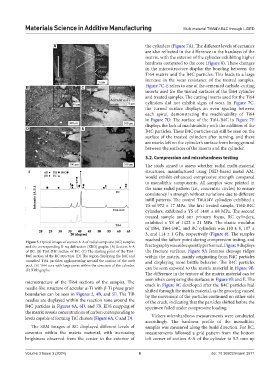
            Figure 5. Optical images of section A-A of radial composite (RC) samples
            and the corresponding X-ray diffraction (XRD) graphs. (A) Section A-A   fractography was subsequently performed. Figure 9 displays
            of RC. (B) Ti64-B4C section of RC. (C) The starting point of the Ti64-  the fracture surfaces.  Figure  9A features cleavage ridges
            B4C section of the RC structure. (D) The region displaying the B4C and   within the matrix, mainly originating from B4C particles
            unmelted Ti64 particles agglomerating around the surface of the melt   and displaying more brittle behavior. The B4C particles
            pool. (E) Ti64 core with large pores within the structure of the cylinder.   can be seen exposed to the matrix material in Figure 9B.
            (F) XRD graphs.
                                                               The difference in the texture of the matrix material can be
                                                               seen when comparing the surfaces in Figure 9B and E. The
            microstructure of the Ti64  sections of the samples. The   crack in Figure 9C developed after the B4C particles had
            needle-like structure of acicular α-Ti with β-Ti phase grain   shifted through the matrix material, as the grooving caused
            boundaries can be seen in Figures 2, 4B, and 5E. The TiB   by the movement of the particles continued on either side
            needles are displayed within the reaction zone around the   of the crack, indicating that the particles shifted before the
            B4C particles in Figures 6A, 6D, and 7B. EDS mapping of   specimen failed under compressive loading.
            the matrix reveals concentrations of carbon corresponding to
            levels capable of forming TiC clusters (Figure 6A, C and D).  Vickers microhardness measurements were conducted
                                                               accordingly.  The  hardness  profile  of  the  monolithic
              The SEM images of RC displayed different levels of   samples was measured along the build direction. For RC,
            ceramics within the matrix material, with increasing   measurements followed a grid pattern from the bottom
            brightness  observed from the center to the exterior  of   left corner of section A-A of the cylinder to 5.5 mm up


            Volume 3 Issue 3 (2024)                         6                              doi: 10.36922/msam.3571

