


Page 16 - MSAM-3-3
P. 16
Materials Science in Additive Manufacturing                        Multi-material Ti6Al4V-B4C through L-DED


                         A                                   B


                         C                                   D


                         E                                   F


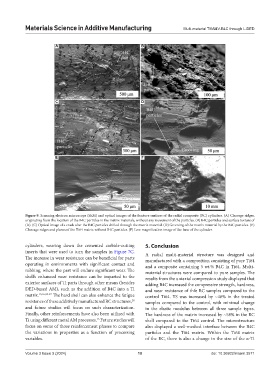
            Figure 9. Scanning electron microscope (SEM) and optical images of the fracture surfaces of the radial composite (RC) cylinders. (A) Cleavage ridges,
            originating from the location of the B4C particles in the matrix materials, without any movement of the particles. (B) B4C particles and surface texture of
            (A). (C) Optical image of a crack after the B4C particles shifted through the matrix material. (D) Grooving of the matrix material by the B4C particles. (E)
            Cleavage ridges and planes of the Ti64 matrix without B4C particles. (F) Low magnification image of the base of the cylinder.


            cylinders, wearing down the cemented carbide-cutting   5. Conclusion
            inserts that were used to turn the samples in Figure 7C.   A radial multi-material structure  was designed and
            The increase in wear resistance can be beneficial for parts   manufactured with a composition consisting of pure Ti64
            operating in environments with significant contact and   and a composite containing 5 wt.% B4C in Ti64. Multi-
            rubbing, where the part will endure significant wear. The   material structures were compared to pure samples. The
            shell’s enhanced wear resistance can be imparted to the   results from the uniaxial compression study displayed that
            exterior surfaces of Ti parts through other means (besides   adding B4C increased the compressive strength, hardness,
            DED-based AM), such as the addition of B4C into a Ti   and wear resistance of thfe RC samples compared to the
            matrix. 15,16,25-27  The hard shell can also enhance the fatigue   control Ti64. YS was increased by ~48% in the treated
            resistance of these additively manufactured RC structures,    samples compared to the control, with minimal change
                                                         28
            and future studies will focus on such characterization.   in the elastic modulus between all three sample types.
            Finally, other reinforcements have also been utilized with   The hardness of the matrix increased by ~58% in the RC
            Ti using different metal AM processes.  Future studies will   shell compared to the Ti64 control. The microstructure
                                          15
            focus on some of those reinforcement phases to compare   also displayed a well-meshed interface between the B4C
            the  variations  in properties  as  a function of  processing   particles and the Ti64 matrix. Within the Ti64 matrix
            variables.                                         of the RC, there is also a change in the size of the α-Ti


            Volume 3 Issue 3 (2024)                         10                             doi: 10.36922/msam.3571

