


Page 15 - MSAM-3-3
P. 15
Materials Science in Additive Manufacturing                        Multi-material Ti6Al4V-B4C through L-DED


                         A


                         C


                         D                                   E


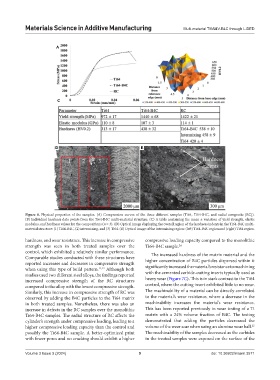
            Figure 8. Physical properties of the samples. (A) Compression curves of the three different samples (Ti64, Ti64-B4C, and radial composite [RC]).
            (B) Individual hardness data points from the Ti64-B4C multi-material structure. (C) A table containing the mean ± variation of yield strength, elastic
            modulus, and hardness values for the compositions (n = 3). (D) Optical image displaying the overall region of the hardness indents in the Ti64-B4C multi-
            material structure: (1) Ti64-B4C, (2) intermixing, and (3) Ti64. (E) Optical image of the intermixing region: (left) Ti64-B4C region and (right) Ti64 region.

            hardness, and wear resistance. This increase in compressive   compressive loading capacity compared to the monolithic
            strength was  seen  in  both  treated  samples  over  the   Ti64-B4C sample. 24
            control, which exhibited a relatively similar performance.   The increased hardness of the matrix material and the
            Comparable studies conducted with these structures have   higher concentration of B4C particles dispersed within it
            reported increases and decreases in compressive strength
            when using this type of build pattern. 11,12  Although both   significantly increased the material’s resistance to machining
            studies used two different steel alloys, the findings reported   with the cemented carbide-cutting inserts typically used as
            increased compressive strength of the RC structures   heavy wear (Figure 7C). This is in stark contrast to the Ti64
            compared to the alloy with the lowest compressive strength.   control, where the cutting insert exhibited little to no wear.
            Similarly, this increase in compressive strength of RC was   The machinability of a material can be directly correlated
            observed by adding the B4C particles to the Ti64 matrix   to the material’s wear resistance, where a decrease in the
            in both treated samples. Nonetheless, there was also an   machinability increases the material’s wear resistance.
            increase in defects in the RC samples over the monolithic   This has been reported previously in wear testing of a Ti
            Ti64-B4C samples. The radial structure of RC affects the   matrix with a 24% volume fraction of B4C. The testing
            cylinder’s strength under compressive loading, leading to a   demonstrated that  adding  the particles  decreased  the
            higher compressive loading capacity than the control and   volume of the wear scar when using an alumina wear ball.
                                                                                                            25
            possibly the Ti64-B4C sample. A  better-optimized print   The machinability of the samples decreased as the carbides
            with fewer pores and no cracking should exhibit a higher   in the treated samples were exposed on the surface of the


            Volume 3 Issue 3 (2024)                         9                              doi: 10.36922/msam.3571

