


Page 88 - OR-1-2
P. 88
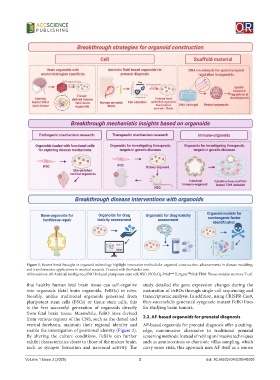
Figure 1. Recent breakthroughs in organoid technology highlight innovative methods for organoid construction, advancements in disease modeling,
            and transformative applications in medical research. Created with BioRender.com.
            Abbreviations: AI: Artificial intelligence; iPSC: Induced pluripotent stem cell; NSG: NOD.Cg-Prkd cscid  IL2rgtm 1Wjl /SzJ; TRM: Tissue-resident memory T cell.

            that healthy human fetal brain tissue can self-organize   study  detailed  the  gene  expression  changes  during  the
            into organoids (fetal brain organoids, FeBOs)  in vitro.   maturation of FeBOs through single-cell sequencing and
            Notably, unlike traditional organoids generated from   transcriptomic analysis. In addition, using CRISPR-Cas9,
            pluripotent stem cells (PSCs) or tissue stem cells, this   they successfully generated syngeneic mutant FeBO lines
            is the first successful generation of organoids directly   for studying brain tumors.
            from  fetal  brain  tissue.  Meanwhile,  FeBO  lines  derived
            from various regions of the CNS, such as the dorsal and   2.2. AF-based organoids for prenatal diagnosis
            ventral forebrain, maintain their regional identity and   AF-based organoids for prenatal diagnosis offer a cutting-
            enable the investigation of positional identity (Figure 2).   edge, non-invasive alternative to traditional prenatal
            By altering the culture conditions, FeBOs can further   screening methods. Instead of relying on invasive techniques
            exhibit characteristics closer to those of the mature brain,   such as amniocentesis or chorionic villus sampling, which
            such as synapse formation and neuronal activity. The   carry some risks, this approach uses AF itself as a source

            Volume 1 Issue 2 (2025)                         3                            doi: 10.36922/OR025040005

