


Page 93 - OR-1-2
P. 93
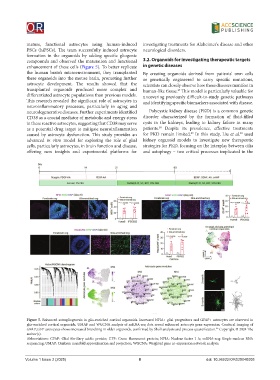
mature, functional  astrocytes  using human-induced   investigating treatments for Alzheimer’s disease and other
            PSCs (hiPSCs). The team successfully induced astrocyte   neurological disorders.
            formation in the organoids by adding specific gliogenic
            compounds and observed the maturation and functional   3.2. Organoids for investigating therapeutic targets
            enhancement of these cells (Figure 5). To better replicate   in genetic diseases
            the human brain’s microenvironment, they transplanted   By creating organoids derived from patients’ own cells
            these organoids into the mouse brain, promoting further   or genetically  engineered to carry specific  mutations,
            astrocyte development. The results showed that the   scientists can closely observe how these diseases manifest in
            transplanted organoids produced more complex and   human-like tissue.  This model is particularly valuable for
                                                                             37
            differentiated astrocyte populations than previous models.   uncovering previously difficult-to-study genetic pathways
            This research revealed the significant role of astrocytes in   and identifying specific biomarkers associated with disease.
            neuroinflammatory processes, particularly in aging and
            neurodegenerative diseases. Further experiments identified   Polycystic kidney disease (PKD) is a common genetic
            CD38 as a crucial mediator of metabolic and energy stress   disorder characterized by the formation of fluid-filled
            in these reactive astrocytes, suggesting that CD38 may serve   cysts in  the kidneys,  leading  to kidney failure in many
                                                                     38
            as a potential drug target to mitigate neuroinflammation   patients.  Despite its prevalence, effective treatments
                                                                                                       40
            caused  by  astrocyte  dysfunction.  This  study  provides  an   for PKD remain limited.  In this study, Liu et al.  used
                                                                                  39
            advanced  in  vitro  model  for  exploring  the  role  of  glial   kidney organoid models to investigate new therapeutic
            cells, particularly astrocytes, in brain function and disease,   strategies for PKD, focusing on the interplay between cilia
            offering new insights and experimental platforms for   and autophagy – two critical processes implicated in the


            Figure 5. Enhanced astrogliogenesis in glia-enriched cortical organoids. Increased NFIA+ glial progenitors and GFAP+ astrocytes are observed in
            glia-enriched cortical organoids. UMAP and WGCNA analysis of snRNA-seq data reveal enhanced astrocyte gene expression. Confocal imaging of
            GFAP::GFP astrocytes shows increased branching in older organoids, confirmed by Sholl analysis and process quantification.  Copyright © 2024 The
                                                                                             36
            author(s).
            Abbreviations: GFAP: Glial fibrillary acidic protein; GFP: Green fluorescent protein; NFIA: Nuclear factor I A; snRNA-seq: Single-nucleus RNA
            sequencing; UMAP: Uniform manifold approximation and projection; WGCNA: Weighted gene co-expression network analysis.


            Volume 1 Issue 2 (2025)                         8                            doi: 10.36922/OR025040005

