


Page 97 - OR-1-2
P. 97
A                                                                    C


                                                                                  D


             B


                                                                                  E


             F                                               G


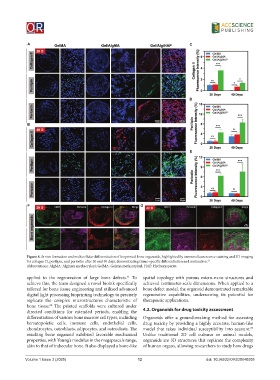
            Figure 8. In vivo formation and multicellular differentiation of bioprinted bone organoids, highlighted by immunofluorescence staining and 3D imaging
            for collagen II, perilipin, and periostin after 20 and 40 days, demonstrating tissue-specific differentiation and maturation. 61
            Abbreviations: AlgMA: Alginate methacryloyl; GelMA: Gelatin methacryloyl; HAP: Hydroxyapatite.

            applied  to the regeneration of  large bone  defects.  To   spatial topology with porous micro-nano structures and
                                                       61
            achieve this, the team designed a novel bioink specifically   achieved centimeter-scale dimensions. When applied to a
            tailored for bone tissue engineering and utilized advanced   bone defect model, the organoid demonstrated remarkable
            digital light processing bioprinting technology to precisely   regenerative capabilities, underscoring its potential for
            replicate the complex microstructures characteristic of   therapeutic applications.
            bone tissue.  The printed scaffolds were cultured under
                      62
            directed conditions for extended periods, enabling the   4.2. Organoids for drug toxicity assessment
            differentiation of various bone marrow cell types, including   Organoids offer a groundbreaking method for assessing
            hematopoietic cells, immune cells, endothelial cells,   drug toxicity by providing a highly accurate, human-like
            chondrocytes, osteoblasts, adipocytes, and osteoclasts. The   model that takes individual susceptibility into account.
                                                                                                            63
            resulting bone organoid exhibited favorable mechanical   Unlike traditional 2D cell cultures or animal models,
            properties, with Young’s modulus in the megapascals range,   organoids are 3D structures that replicate the complexity
            akin to that of trabecular bone. It also displayed a bone-like   of human organs, allowing researchers to study how drugs


            Volume 1 Issue 2 (2025)                         12                           doi: 10.36922/OR025040005

