


Page 94 - OR-1-2
P. 94
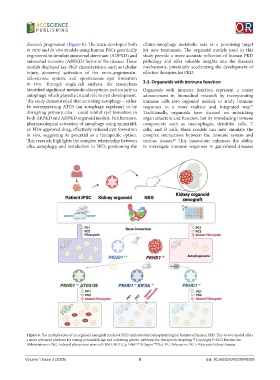
disease’s progression (Figure 6). The team developed both   cilium-autophagy metabolic axis as a promising target
            in vitro and in vivo models using human PSCs genetically   for new treatments. The organoid models used in this
            engineered to simulate autosomal dominant (ADPKD) and   study provide a more accurate reflection of human PKD
            autosomal recessive (ARPKD) forms of the disease. These   pathology and offer valuable insights into the disease’s
            models displayed key PKD characteristics, such as tubular   mechanisms, potentially accelerating the development of
            injury, abnormal activation of the renin-angiotensin-  effective therapies for PKD.
            aldosterone  system,  and  spontaneous  cyst  formation
            in vivo. Through single-cell analysis, the researchers   3.3. Organoids with immune function
            identified significant metabolic disruptions, particularly in   Organoids with immune function represent a major
            autophagy, which played a crucial role in cyst development.   advancement in biomedical research by incorporating
            The study demonstrated that activating autophagy – either   immune  cells  into  organoid  models  to  study  immune
            by  overexpressing  ATG5  (an  autophagy  regulator)  or  by   responses in a more realistic and integrated way.
                                                                                                            41
            disrupting primary cilia – could inhibit cyst formation in   Traditionally,  organoids  have  focused  on  mimicking
            both ARPKD and ADPKD organoid models. Furthermore,   organ structure and function, but by introducing immune
            pharmacological activation of autophagy using minoxidil,   components such as macrophages, dendritic cells, T
            an FDA-approved drug, effectively reduced cyst formation   cells,  and  B  cells,  these  models  can  now  simulate  the
            in vivo, suggesting its potential as a therapeutic option.   complex interactions between the immune system and
            This research highlights the complex relationship between   various tissues.  This innovation enhances the ability
                                                                           42
            cilia, autophagy, and metabolism in PKD, positioning the   to investigate immune responses in gut-related diseases


            Figure 6. The multiple roles of an organoid xenograft model of PKD replicates key pathophysiological features of human PKD. This in vivo model offers
                                                                                   40
            a more advanced platform for testing potential drugs and validating genetic pathways for therapeutic targeting.  Copyright © 2023 Elsevier Inc.
            Abbreviations: iPSC: Induced pluripotent stem cell; NSG: NOD.Cg-Prkd cscid  IL2rgtm 1Wjl /SzJ; PC: Polycystin; PKD: Polycystic kidney disease.

            Volume 1 Issue 2 (2025)                         9                            doi: 10.36922/OR025040005

