


Page 17 - OR-1-3
P. 17
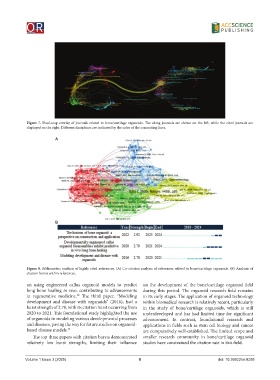
Figure 7. Dual-map overlay of journals related to bone/cartilage organoids. The citing journals are shown on the left, while the cited journals are
            displayed on the right. Different disciplines are indicated by the color of the connecting lines.

                         A


                         B


            Figure 8. Bibliometric analysis of highly cited references. (A) Co-citation analysis of references related to bone/cartilage organoids. (B) Analysis of
            citation bursts within references.

            on using engineered callus organoid models to predict   on the development of the bone/cartilage organoid field
            long bone healing in vivo, contributing to advancements   during this period. The organoid research field remains
                                  32
            in regenerative medicine.  The third paper, “Modeling   in its early stages. The application of organoid technology
            development and disease with organoids” (2016), had a   within biomedical research is relatively recent, particularly
            burst strength of 2.78, with its citation burst occurring from   in the study of bone/cartilage organoids, which is still
            2020 to 2021. This foundational study highlighted the use   underdeveloped and has had limited time for significant
            of organoids in modeling various developmental processes   advancement.  In  contrast,  foundational  research  and
            and diseases, paving the way for future studies on organoid-  applications in fields such as stem cell biology and cancer
            based disease models. 42                          are comparatively well-established. The limited scope and
               The top three papers with citation bursts demonstrated   smaller research community in bone/cartilage organoid
            relatively low burst strengths, limiting their influence   studies have constrained the citation rate in this field.


            Volume 1 Issue 3 (2025)                         8                                 doi: 10.36922/or.8295

