


Page 15 - OR-1-3
P. 15
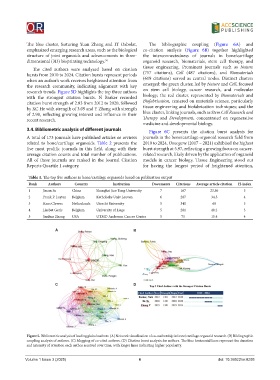
The blue cluster, featuring Yuan Zhang and IT Ozbolat,   The bibliographic coupling (Figure  6A) and
            emphasized emerging research areas, such as the biological   co-citation analysis (Figure  6B) together highlighted
            structure of joint organoids and advancements in three-  the  interconnectedness  of  journals  in  bone/cartilage
            dimensional (3D) bioprinting technology. 30       organoid  research,  biomaterials, stem  cell therapy, and

               The cited authors were analyzed based on citation   tissue engineering. Prominent journals such as  Nature
            bursts from 2010 to 2024. Citation bursts represent periods   (757 citations),  Cell (487 citations), and  Biomaterials
            when an author’s work receives heightened attention from   (619 citations) served as central nodes. Distinct clusters
            the research community, indicating alignment with key   emerged: the green cluster, led by Nature and Cell, focused
            research trends. Figure 5D highlights the top three authors   on stem cell biology, cancer research, and molecular
            with the strongest citation bursts. N  Barker recorded   biology; the red cluster, represented by  Biomaterials and
            citation burst strength of 2.83 from 2012 to 2020, followed   Biofabrication, centered on materials science, particularly
            by XC He with strength of 3.09 and Y Zhang with strength   tissue engineering and biofabrication techniques; and the
            of 2.98, reflecting growing interest and influence in their   blue cluster, linking journals, such as Stem Cell Research and
            recent research.                                  Therapy and  Development, concentrated on regenerative
                                                              medicine and developmental biology.
            3.4. Bibliometric analysis of different journals    Figure  6C presents the citation burst analysis for
            A total of 173 journals have published articles or reviews   journals in the bone/cartilage organoid research field from
            related to bone/cartilage organoids.  Table 2 presents the   2010 to 2024. Oncogene (2017 – 2021) exhibited the highest
            five most prolific journals in this field, along with their   burst strength at 5.97, reflecting a growing focus on cancer-
            average citation counts and total number of publications.   related research, likely driven by the application of organoid
            All of these journals are ranked in the Journal Citation   models in cancer biology. Tissue Engineering stood out
            Reports Quartile 1 category.                      for having the longest period of heightened attention,

             Table 1. The top five authors in bone/cartilage organoids based on publication output
             Rank    Authors     Country         Institution      Documents  Citations  Average article citation  H‑index
             1     Jiacan Su    China     Shanghai Jiao Tong University  7    167         23.86          5
             2     Frank P. Luyten  Belgium  Katholieke Univ Leuven  6        207          34.5          4
             3     Hans Clevers  Netherlands  Utrecht University     5        340          68            5
             4     Liesbet Geris  Belgium  University of Liege       5        201          40.2          3
             5     Jianhua Zhang   USA    UTMD Anderson Cancer Center  5      75           15.4          4

                         A                                B


                         C                                D


            Figure 5. Bibliometric analysis of leading global authors. (A) Network visualization of co-authorship in bone/cartilage organoid research. (B) Bibliographic
            coupling analysis of authors. (C) Mapping of co-cited authors. (D) Citation burst analysis for authors. The blue horizontal lines represent the duration
            and intensity of attention each author received over time, with longer lines indicating higher popularity.


            Volume 1 Issue 3 (2025)                         6                                 doi: 10.36922/or.8295

