


Page 14 - OR-1-3
P. 14
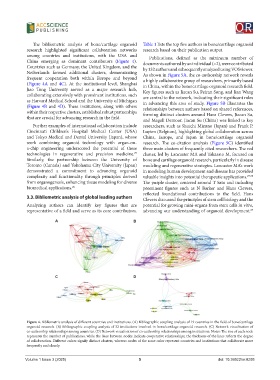
The bibliometric analysis of bone/cartilage organoid   Table 1 lists the top five authors in bone/cartilage organoid
            research highlighted significant collaboration networks   research based on their publication output.
            among countries and institutions, with the USA and   Publications, defined as the minimum number of
            China emerging as dominant contributors (Figure  4).   documents authored by an individual (>2), were contributed
            Countries such as Germany, the United Kingdom, and the   by 132 authors and subsequently analyzed using VOSviewer.
            Netherlands formed additional clusters, demonstrating   As shown in Figure 5A, the co-authorship network reveals
            frequent cooperation both within Europe and beyond   a highly collaborative group of researchers, primarily based
            (Figure  4A  and  4C). At the institutional level, Shanghai   in China, within the bone/cartilage organoid research field.
            Jiao Tong University served as a major research hub,   Key figures such as Jiacan Su, Peiran Song, and Jian Wang
            collaborating extensively with prominent institutions, such   are central to the network, indicating their significant roles
            as Harvard Medical School and the University of Michigan   in advancing this area of study.  Figure  5B illustrates the
            (Figure  4B  and  4D). These institutions, along  with others   relationships between authors based on shared references,
            within their respective clusters, established robust partnerships   forming distinct clusters around Hans Clevers, Jiacan Su,
            that are crucial for advancing research in the field.
                                                              and Magali Demoor. Jiacan Su (China) was linked to key
               Further examples of international collaboration include   researchers, such as Shuichi Mizuno (Japan) and Frank P.
            Cincinnati Children’s Hospital Medical Center (USA)   Luyten (Belgium), highlighting global collaboration across
            and Tokyo Medical and Dental University (Japan), whose   China,  Europe,  and Japan in  bone/cartilage  organoid
            work combining organoid technology with organ-on-  research. The co-citation analysis (Figure  5C) identified
            a-chip engineering underscored the potential of these   three main clusters of frequently cited researchers. The red
            technologies in regenerative and precision medicine.    cluster, led by Lancaster MA and Takasato M, focused on
                                                          25
            Similarly, the partnership between the University of   bone and cartilage organoid research, particularly in disease
            Toronto (Canada) and Yokohama City University (Japan)   modeling and regenerative strategies. Lancaster MA’s work
            demonstrated a commitment to advancing organoid   in modeling human development and disease has provided
            complexity  and  functionality  through  principles  derived   valuable insights into potential therapeutic applications. 27,28
            from organogenesis, enhancing tissue modeling for diverse   The purple cluster, centered around T Sato and including
            biomedical applications. 26                       prominent  figures such as N Barker and Hans Clevers,
                                                              reflected foundational  contributions  to  the field. Hans
            3.3. Bibliometric analysis of global leading authors  Clevers discussed the principles of stem cell biology and the
            Analyzing authors can identify key  figures that are   potential for growing mini-organs from stem cells in vitro,
            representative of a field and serve as its core contributors.   advancing our understanding of organoid development.
                                                                                                            29
                         A                                B


                         C                                D


            Figure 4. Bibliometric analysis of different countries and institutions. (A) Bibliographic coupling analysis of 19 countries in the field of bone/cartilage
            organoid research. (B) Bibliographic coupling analysis of 32 institutions involved in bone/cartilage organoid research. (C) Network visualization of
            co-authorship relationships among countries. (D) Network visualization of co-authorship relationships among institutions. Notes: The size of each node
            represents the number of publications, while the lines between nodes indicate cooperative relationships; the thickness of the lines reflects the degree
            of collaboration. Different colors signify distinct clusters, whereas nodes of the same color represent countries and institutions that collaborate more
            frequently and closely.


            Volume 1 Issue 3 (2025)                         5                                 doi: 10.36922/or.8295

