


Page 13 - TD-2-2
P. 13
Tumor Discovery                                             Practice and consideration of master protocol design


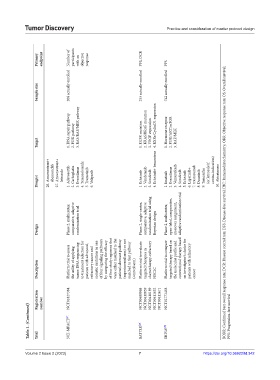
                 Primary   endpoint  Number of   participants   with an   objective   response  PFS, DCR  PFS


                 Sample size  208 actually enrolled          255 actually enrolled  742 actually enrolled


                              1. DNA repair pathway  2. PI3K pathway 3. RAS/RAF/MEK pathway  1. EGFR mutation  2. KRAS/BRAF mutation  3. VEGF expression 4. RXRs/CyclinD1 expression  1. Hormone receptor  2. PI3K/AKT/mTOR


                 Target                                                     3. RAF/MEK


                      26.   Amcenestrant+   abemaciclib  27.   Amcenestrant+   letrozole  1. Adavosertib  2. Carboplatin  4. Temozolomide  4. Erlotinib+ bexarotene  3. Vemurafenib  7. trastuzumab  (or letrozole if   contra-indication)  10. Abiraterone


                 Drug(s)          3. Everolimus  5. Trametinib  6. Veliparib  1. Erlotinib  2. Vandetanib  3. Sorafenib  1. Imatinib  2. Everolimus  4. Sorafenib  5. Erlotinib  6. Lapatinib+  8. Dasatinib  9.   Tamoxifen


                              Phase 2, multicenter,   comparative, adaptive   randomization trial  Phase 2, single-center,   comparative, adaptive   randomization trial using   Bayesian design  Phase 2, multicenter,   open-label, comparative,   crossover assignment,  adaptive randomization trial BORR: Confirmed best overall response rate; DCR: Disease control rate; DFS: Disease-free survival; IHC: Immunohistochemistry; ORR: Objective response rate; OS: Overall survival;


                 Design


                 Description  Platform trial to assess   the utility of applying   tumor DNA sequencing   to treatment selection for   patients with advanced,   refractory cancer and   somatic mutations in one  of four signaling pathways   by comparing the efficacy  of four study regimens that  were either matched to the  patient’s aberrant pathway  (experimental arm) or not   matched to that pathway   (control arm)  Platform trial to evaluate   targeted therapies in   ch


                 Registration   number  NCT01827384          NCT00409968  NCT00410059  NCT00410189  NCT00411632  NCT00411671  NCT01771458

             Table 1. (Continued)  Trial  NCI-MPACT [27]     BATTLE [28]  SHIVA [29]               PFS: Progression-free survival


            Volume 2 Issue 2 (2023)                         7                           https://doi.org/10.36922/td.342

