


Page 16 - TD-2-2
P. 16
Tumor Discovery                                             Practice and consideration of master protocol design


            Table 2. (Continued)
            Trial        NCT number  Description      Design      Intervention  Sample size  Primary endpoint
                                                                                             4.  1-year tumor
                                                                                               control-Phase II
                                                                                             5.  Rate of pathologic
                                                                                               complete
                                                                                               response-Gastric
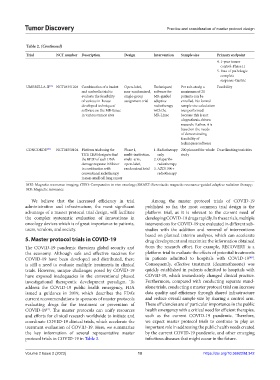
            UMBRELLA-II [13]  NCT04351204 Combination of a basket   Open-label,   Techniques/  Per sub-study, a   Feasibility
                                    and umbrella trial to   non-randomized,  software for   maximum of 20
                                    evaluate the feasibility   single-group   MR-guided   patients can be
                                    of various in-house   assignment trial  adaptive   enrolled. No formal
                                    developed techniques/         radiotherapy   sample size calculation
                                    software on the MR-Linac      with the    was performed
                                    in various tumor sites        MR-Linac    because this is not
                                                                              a hypothesis-driven
                                                                              research. Rather, it is
                                                                              based on the needs
                                                                              of demonstrating
                                                                              feasibility of
                                                                              techniques/software
            CONCORDE [39]  NCT04550104 Platform trial using the   Phase I,   1.  Radiotherapy  200 planned for whole  Dose limiting toxicities
                                    TiTE CRM design to find   multi-institution,   only  study
                                    the RP2D of each DNA   multi-arm,  2.  Olaparib+
                                    damage response inhibitor   open-label,   radiotherapy
                                    in combination with   randomized trial  3.  AZD1390+
                                    conventional radiotherapy       radiotherapy
                                    in non-small cell lung cancer
            MRI: Magnetic resonance imaging; CIVO: Comparative in vivo oncology; SMART: Stereotactic magnetic resonance-guided adaptive radiation therapy;
            MR: Magnetic resonance
              We believe that the increased efficiency in trial   Among the master protocol trials of COVID-19
            administration and infrastructure, the most significant   published so far, the most common trial design is the
            advantage of a master protocol trial design, will facilitate   platform trial, as it is relevant to the current need of
            the  complex  systematic  evaluation of  innovations  in   developing COVID-19 drugs rapidly. In these trials, multiple
            oncology devices which is of great importance to patients,   interventions for COVID-19 are evaluated in different sub-
            users, vendors, and society.                       studies with the addition and removal of interventions
                                                               based on planned interim analyses, which can accelerate
            5. Master protocol trials in COVID-19              drug development and maximize the information obtained
            The COVID-19 pandemic threatens global security and   from the research effort. For example, RECOVERY is a
            the economy. Although safe and effective vaccines for   platform trial to evaluate the effects of potential treatments
                                                                                                           [40]
            COVID-19 have been developed and distributed, there   in patients admitted to hospitals with COVID-19 .
            is still a need to evaluate multiple treatments in clinical   Consequently, effective treatment (dexamethasone) was
            trials. However, unique challenges posed by COVID-19   quickly established in patients admitted to hospitals with
            have exposed inadequacies in the conventional phased   COVID-19, which immediately changed clinical practice.
            investigational therapeutic development paradigm. To   Furthermore, compared with conducting separate stand-
            address the COVID-19 public health emergency, FDA   alone trials, conducting a master protocol trial can increase
            issued a guidance in 2019, which describes the FDA’s   data quality and efficiency through shared infrastructure
            current recommendations to sponsors of master protocols   and reduce overall sample size by sharing a control arm.
            evaluating  drugs  for  the  treatment  or  prevention  of   These efficiencies are of particular importance in the public
            COVID-19 . The master protocols can unify resources   health emergency with a critical need for efficient therapies,
                     [2]
            and efforts for clinical research worldwide to initiate and   such as the current COVID-19 pandemic. Therefore,
            coordinate COVID-19 clinical trials, which accelerate the   we expect master protocol trials to continue to play an
            treatment evaluation of COVID-19. Here, we summarize   important role in addressing the public health needs created
            the key information of several representative master   by the current COVID-19 pandemic, and other emerging
            protocol trials in COVID-19 in Table 3.            infectious diseases that might occur in the future.


            Volume 2 Issue 2 (2023)                         10                          https://doi.org/10.36922/td.342

