


Page 65 - TD-3-3
P. 65
Tumor Discovery                                            Pyroptosis-related genes in breast cancer progression


            Table 1. Primers used in qPCR                      that there were significant differences in overall survival
                                                               (OS) times between the two clusters (P < 0.001; Figure 4C).
            Oligo name Sequence (5’ to 3’)
            ARMH1     Forward: GGC AGC AAT TAG CAG GCT CTT     3.3. Establishment and validation of pyroptosis-
                      Reverse: GAA CTT GTC GAG GAT GTG ACT C   related gene prognostic model
            PXDNL     Forward: GAG ACC TTC TGA GAT TAG AGC GA  We compared the expression of 1,231 genes in 627
                      Reverse: GCG TTG GAA TCC AGA CGC A       BC patients to identify prognosis-related genes using
            APOBEC3D Forward: CTT TCG AGG CCC GGT ACT AC       univariate Cox  regression analysis.  Fifty-five  genes  were
                      Reverse: GTG ATC TGG AAG CGC CTG TTA     selected for further analysis (P < 0.01; Figure 5A). Among
            APOBEC3F  Forward: CTT CAG AAA CAC AGT GGA GCG AAT G  these, five high-risk genes were fibrinogen C domain-
                                                               containing  1  (FIBCD1),  calcium  voltage-gated  channel
                      Reverse: GTA GCA CAG CCA GAC GGT ATT CC  subunit alpha1 H (CACNA1H),  FAM234B, heat shock
            GAPDH     Forward: CAT GAG AAG TAT GAC AAC AGC CT  protein family B (small) member 8 (HSPB8), and PXDNL,
                      Reverse: AGT CCT TCC ACG ATA CCA AAG T   while the remaining 50 genes were low-risk genes. Based
            Abbreviations: qPCR: quantitative polymerase chain reaction. PXDNL:   on the optimal value, 15 gene signatures were generated
            Peroxidasin-like; ARMH1: Armadillo-like helical domain-containing 1.  using the least absolute shrinkage and selection operator
                                                               Cox regression analysis (Figure 5B and C).
            3. Results
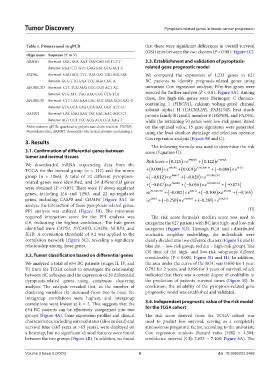
                                                                 The following formula was used to determine the risk
            3.1. Confirmation of differential genes between    score (Equation II):
            tumor and normal tissues
                                                                                            )
                                                               Risk    = Score  ( 0.125 )×  FIBCD 1  +e  (0.122 e PXDNL
            We downloaded mRNA sequencing data from the
                                                                                   )
                                                                                            (
            TCGA for the normal group (n = 112) and the tumor   ( + 0.099 )×e HSPE 8  + (0.019 e CACNA 1H  +−0.008 )×e RGS 1
            group (n = 1066). A  total of 52 different pyroptosis-  ( +  −  )×0.012  MMP 7  +  (− e  )×0.029  e APOBEC 3D
            related genes were identified, and 39 differential genes      PSME 2  +−0.058  APOBEC 3F  +−0.073 )
                                                                                                 (
                                                                               (
            were obtained (P < 0.05). There were 17 down-regulated   ( + −0.047 )×e   )×e
                                                                        (
                                                                                       (
                                                                                                     (
            genes, including  IL6 and  TP63, and 22 up-regulated   ×e KLHDC 7B  +−0.082 )×e RAC 2  +−0.100 )×e MATK  +−0.165 )
                                                                      (
            genes, including  CASP8 and  CHMP6 (Figure  3A). To   ×e DEF 6  +−0.250 )×e APMH 1  +− ( 0.281) e DIRAS 3
                                                                                            ×
            analyze the interaction of these pyroptosis-related genes,
            PPI analysis was utilized (Figure  3B). The minimum                                            (II)
            required interaction score for the PPI analysis was   The risk score formula’s median score was used to
            0.9, indicating the highest confidence. The hub genes   categorize the 627 patients with BC into high- and low-risk
            identified were  CAPS1,  PYCARD,  CASP8,  NLRP3, and   categories (Figure  5D).  Through PCA  and t-distributed
            IL1B. A correlation threshold of 0.2 was applied to the   stochastic neighbor embedding, the individuals were
            correlation network (Figure 3C), revealing a significant   clearly divided into two different clusters (Figure 5E and F:
            relationship among these genes.                    blue dot – low-risk group; red dot – high-risk group). The
                                                               OS time of the high-  and low-risk subgroups differed
            3.2. Tumor classification based on differential genes  considerably (P < 0.001, Figure 5G and H). In addition,
            We analyzed a total of 654 BC patients (stages II, IV, and   the area under the curve of the ROC was 0.650 for 1 year,
            V) from the TCGA cohort to investigate the relationship   0.792 for 2 years, and 0.696 for 3 years of survival, which
            between BC subtypes and the expression of 39 differential   indicated that there was a certain degree of credibility in
            pyroptosis-related genes using  consensus  clustering   the prediction of patients’ survival times (Figure  5I). In
            analysis. The analysis revealed that, as the number of   conclusion, the reliability of the pyroptosis-related gene
            clustering  variables  (k)  increased  from  two  to  nine,  the   prognostic model was established and validated.
            intragroup  correlations  were  highest,  and  intergroup
            correlations were lowest at  k = 2. This suggests that the   3.4. Independent prognostic value of the risk model
            654 BC patients can be effectively categorized into two   for the TCGA cohort
            groups (Figure 4A). Gene expression profiles and clinical   The risk score derived from the TCGA cohort was
            characteristics, including survival status (alive or dead) and   used to predict low survival, serving as a completely
            survival time (≤65 years or >65 years), were displayed on   autonomous prognostic factor, according to the univariate
            a heatmap, but no significant clinical features were found   Cox regression analysis (hazard ratio [HR]  = 4.504;
            between the two groups (Figure 4B). In addition, we found   confidence interval [CI]: 2.855 − 7.108; Figure 6A). The


            Volume 3 Issue 3 (2024)                         6                                 doi: 10.36922/td.3469

