


Page 72 - TD-3-3
P. 72
Tumor Discovery                                            Pyroptosis-related genes in breast cancer progression


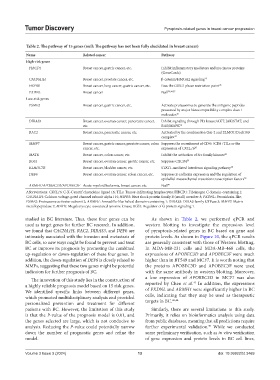
            Table 2. The pathway of 15 genes (null: The pathway has not been fully elucidated in breast cancer)
            Name                    Related cancer                    Pathway
            High-risk genes
             FIBCD1                 Breast cancer, gastric cancer, etc.  Inhibit inflammatory mediators and mucinous proteins
                                                                      (GeneCards)
             CACNA1H                Breast cancer, prostate cancer, etc.  β-catenin/HMGA2 signaling 13
             HSPB8                  Breast cancer, lung cancer, gastric cancer, etc.  Pass the G0/G1 phase restriction point 26
             PXDNL                  Breast cancer                     Null 29,36,37
            Low-risk genes
             PSME2                  Breast cancer, gastric cancer, etc.  Activate proteasomes to generate the antigenic peptides
                                                                      presented by major histocompatibility complex class I
                                                                      molecules 38
             DIRAS3                 Breast cancer, ovarian cancer, pancreatic cancer,   Inhibit signaling through PI3 kinase/AKT, JAK/STAT, and
                                    etc.                              RAS/MAPK 16
             RAC2                   Breast cancer, pancreatic cancer, etc.  Activated by the combination Gαi-2 and ELMO1/Dock180
                                                                      comple× 17
             MMP7                   Breast cancer, gastric cancer, prostate cancer, colon  Suppress the recruitment of CD4+/CD8+TILs or the
                                    cancer, etc.                      expression of CXCL16 18
             MATK                   Breast cancer, colon cancer, etc.  Inhibit the activation of Src family kinases 22
             RGS1                   Breast cancer, ovarian cancer, gastric cancer, etc.  Suppress CXCR4 39
             KLHDC7B                Breast cancer, bladder cancer, etc.  STAT1-mediated interferon signaling pathway 40
             DEF6                   Breast cancer, ovarian cancer, colon cancer, etc.  Suppress E-cadherin expression and the regulation of
                                                                      epithelial-mesenchymal transition transcription factors 20
             ARMH1/APOBEC3D/APOBEC3F Acute myeloid leukemia, breast cancer, etc.  Null 41
            Abbreviations: CXCL16: C-X-C motif chemokine ligand 16; TILs: Tumor-infiltrating lymphocytes; FIBCD1: Fibrinogen C domain-containing 1;
            CACNA1H: Calcium voltage-gated channel subunit alpha1 H; HSPB8: Heat shock protein family B (small) member 8; PXDNL: Peroxidasin-like;
            PSME2: Proteasome activator subunit 2; ARMH1: Armadillo-like helical domain-containing 1; DIRAS3: DIRAS family GTPase 3; MMP7: Matrix
            metallopeptidase 7; MATK: Megakaryocyte-associated tyrosine kinase; RGS1: Regulator of G protein signaling 1.

            studied in BC literature. Thus, these four genes can be   As shown in  Table 2, we performed qPCR and
            used as target genes for further BC research. In addition,   western blotting to investigate the expression level
            we found that CACNA1H, RAC2, DIRAS3, and DEF6 are   of pyroptosis-related genes in BC based on gene and
            intimately associated with the invasion and metastasis of   protein levels. As shown in Figure 10, the qPCR results
            BC cells, so new ways might be found to prevent and treat   are generally consistent with those of Western blotting.
            BC or improve its prognosis by promoting the combined   In MDA-MB-231  cells and MDA-MB-468  cells, the
            up-regulation or down-regulation of these four genes. In   expressions of APOBEC3D and APOBEC3F were much
            addition, the down-regulation of DEF6 is closely related to   higher than in BT549 and MCF7. It is worth noting that
            MMPs, suggesting that these two genes might be potential   the proteins APOBEC3D and APOBEC3F were used
            indicators for further prognosis of BC.            with the same antibody in western blotting. Moreover,

              The innovation of this study lies in the construction of   a low expression of  APOBEC3D in MCF7 was also
                                                                                   42
            a highly reliable prognosis model based on 15 risk genes.   reported by Chen  et al.  In addition, the expressions
            We identified specific links between different genes,   of PXDNL and ARMH1 were significantly higher in BC
            which promoted multidisciplinary analysis and provided   cells, indicating that they may be used as therapeutic
                                                                          43,44
            personalized prevention and treatment for different   targets in BC.
            patients with BC. However, the limitation of this study   Similarly, there are several limitations to this study.
            is that the  P-value of the prognosis model is 0.01, and   Primarily, it relies on bioinformatics analysis using data
            the genes selected are large, which is not conducive to   from public databases, meaning that all predictions require
            analysis. Reducing the P-value could potentially narrow   further experimental validation.  While we conducted
                                                                                          45
            down the  number  of prognostic  genes  and refine  the   some preliminary verification, such as in vitro verification
            model.                                             of gene expression and protein levels in BC cell lines,


            Volume 3 Issue 3 (2024)                         13                                doi: 10.36922/td.3469

